5.0 out of 5 stars A Story that Demands to be Told Honestly – A PAGE TURNER – 5 STARS for Jim Rasenberger
April 10, 2011
It is very strange that a story as important as this one has simply not received either the historical attention or public attention that it deserves. Very simply, President Kennedy's people will tell you that prior to entering office, JFK was briefed in a meeting with Eisenhower about plans for CIA trained Cuban exiles (some 1400 in number) to invade Cuba and foment a revolution against Castro. Eisenhower's people deny that this ever happened. Continue reading “Review (Guest): The Brilliant Disaster–JFK, Castro, and America's Doomed Invasion of Cuba's Bay of Pigs”
This book The Threat on the Horizon: An Inside Account of America's Search for Security after the Cold War offers a detailed account of the creation and workings of the now nearly forgotten Aspin-Brown Commission on Intelligence Reform (1995-1996). Its author, Loch Johnson, is a recognized authority on intelligence issues and was on the Commission's staff. This book is in part the result of a promise Johnson made to the Commission's original head, Les Aspin before his death.
Some would dismiss this book as concerning a forgotten footnote in the history of the U.S. Intelligence Community (IC), but this would be a mistake. This book actually provides a detailed chronicle of the only real effort to introduce comprehensive reform in the IC prior to the 9/11 tragedy. It also explains in some detail why these reforms proved ineffective. Perhaps unintentionally, the book also provides an excellent picture of the structure and culture of the IC principals (CIA, DIA, NGA, and NSA) as well as the National Reconnaissance Office (NRO) immediately after the end Cold War. The problems of the IC principals in the mid-1990's do much to explain the problems that beset them today and offer a cautionary tale about intelligence reform.
The story of this Commission's efforts to seriously reform the IC demonstrates how by its composition and approach the Commission was more or less bound to fail. Its final recommendations were superficial and would have done nothing to change the moribund cultures and direction of the IC principals even if they had actually been enacted. Indeed as occurred with intelligence reforms recommended by the 9/11 Commission Report which were for the most part enacted, their lack of substance would have made them ineffective.
Johnson attributes much of the problems with the Aspin-Brown Commission to the untimely death of Les Aspin in 1995. He has a point; Aspin was willing to invest a good deal of himself in the search for intelligence reform and clearly took the matter very seriously. This attitude was reflected in the way the Commission's Staff went about the detailed work need for the Commission to be effective and in the way Commission itself went about fact gathering. Aspin's successor Harold Brown was as brilliant as Aspin, but clearly did not take the Commission's work as seriously.
By any standards this book is a very important one for those interested in reform of the U.S. Intelligence System and the reasons why such reform has always failed.
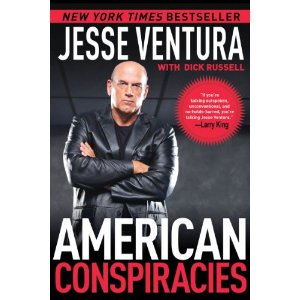
Former Minnesota governor, navy SEAL, and pro rassler Ventura has a new truTVshow investigating but not necessarily debunking conspiracy theories. This companion to the program, a sort of teaser, dissects such famed objects of unending speculation as the JFK, RFK, and MLK assassinations. Ventura concludes that none of those were twisted-loner crimes but rather resulted from conspiracies of varying vastness. Anent the 9/11 terrorist attacks, Ventura asserts that “our government engaged in a massive cover-up” and had “ties to the hijackers.” He ventures that “unanswered questions remain about how the towers were brought down and whether a plane really struck the Pentagon” and that the “Bush Administration either knew about the plan” or “had a hand in it.” Heady, paranoiac stuff, to be sure, but there are even more forthright charges regarding the assassination of Malcolm X, the Jonestown massacre, and the “stolen” elections of 2000, 2004, 2008, and, for that matter, 1980. Believable? Some of it. An action-packed read? You bet. –Mike Tribby
6+ Deep Moral Practical Look at Loss of Integrity Across US National Security
February 28, 2011
FINAL REVIEW
It is difficult for any intelligence book to make it to my 6+ category, or top ten percent. What brings this book to the very top of the heap is the skillful weaving of a constant appraisal of the moral in tandem with the practical. Sight unseen I knew this book would be a five, but it jumped to six when I read it from the back to the front and saw:
Page 354: The Agency has become inbred, ossified, parasitic…a prescription for the abuse of individual rights and fatally flawed analyses of the world-at-large that have plagued CIA over the past 30 years…
In the same concluding chapter he slams Congress for not demanding full access to classified information and the Congressional intelligence committees for serving as controllers of Congressional access rather than oversight bodies, with a particular disdain and disinterest in whistle-blowers; the Pentagon for infecting its own troops with alleged medicine that cause neurological problems, and for consistently covering up and lying to one and all about the causes of Gulf War syndrome; and the US Government generally for isolating “military medicine” from civilian medicine to the point that the troops are guinea pigs for bad science, and then victims of cover-ups that would not be countenanced outside the Pentagon.
As a former direct report to John Guenther, who served along the same lines for many years in Marine Corps counterintelligence in Europe and elsewhere, I have to admire what this author has done and certainly agree that it is useful and important perspective from a ground-level point of view.
I like the names, the photos, the details. HOWEVER, there are two contextual issues that are not well-represented in the book, which is a historical account.
First, the author was and remains unwitting of the fact that the US was funding the Red Brigades and creating a false terrorist threat within Italy in order to further consolidate the power of the fascist government in the post-war period. Only recently has all of this been exposed in the aftermath of the CIA renditions out of Italy, and testimony finally elicited from several participants in the earlier cover operations . In that context then, this book has to be seen as a partial unwitting account. For the tip of the iceberg, see Journal: Nato's Secret Armies (It's Not Terror if CIA Pays and Locals Do the Dirty….) at Phi Beta Iota the Public Intelligence Blog.
In the realm of JFK assassination investigations: lore, irrefutable facts, fiction “factions” and myths, all often compete side-by-side for the right to be accepted. The reader is thus forced to develop a finely tuned “crap-detection system” in order to sort out one from the other.
It is no different in this manuscript produced by Wim Dankbaar, which, as it introduces a new kind of medium (“the investigative internet book”), also blazes its own fresh trail of validated facts in pursuit of uncovering the “real” culprits of the JFK whodunit.
Not a single one of the other reviews mentions “hindsight games” which come at the end in Chapter 12, where Ben Gilad, whom I know and admire, properly lists Helen Ho and Matthew J. Morgan as the authors.
At the age of 58 with 30+ years as an intelligence professional behind me, very little catches me by surprise but this is one of those exquisite “ahas.” For me, the insights into hindsight games as a means to retrospectively identify strategic, operational, tactical, and technical junctures, where participants can reflect on what they knew, what they did not know, what they had wish they had known, and how they might advise the next generation to state its intelligence requirements differently–for me this is an intellectual gold strike.
I have never heard of any of the war colleges or strategy centers or major corporations or NGOs doing hindsight games. This for me is HUGE, and Ben Gilad's integrity is high-density–although the plan of the book properly puts the chapter at the end, after his concepts and doctrine and methods for business war games are outlined, this is the chapter that every one of the eight tribes (academic, civil society, commercial, government, law enforcement, media, military, non-profit or non-governmental) should be thinking about.
Hindsight games are a perfect means of both debriefing out-going executives and mission area specialists, and of transferring lessons learned from one generation to another in a super-professional manner.
I am reminded of Kristan Wheaton's still relevant book, The Warning Solution : Intelligent Analysis in the Age of Information Overload, and believe that would make an excellent HindSight Game pre-read, pulling in seniors and mission area specialists to talk about what proper warning and better intelligence might have allowed them to do these past twenty years.



 6+ Deep Moral Practical Look at Loss of Integrity Across US National Security