John Robb: Drone Diplomacy – Comply or Die + Meta RECAP

07 Other Atrocities, Blog Wisdom, Corruption, Cultural Intelligence, DHS, Director of National Intelligence et al (IC), DoD, Government, IO Deeds of War, Military, Officers Call
0Shares
John Robb

Drone Diplomacy: Comply or Die

Gunboat diplomacy was the essence of military power projection for centuries. Want to coerce a country? Sail a aircraft carrier battle group into their national waters.

However, carrier battlegroups are hideously expensive, increasingly vulnerable to low cost attack, and less lethal than they appear (most of the weapons systems are used for self-defense).

What are nation-states replacing them with? Drones. You can already see it in action across the world as drone staging areas are replacing traditional military bases/entanglements. Further, drones already account for the vast majority of people killed by US forces.

Of course, the reason for this is clear. Drones are relatively cheap, don't require many people to deploy/operate, don't put personnel directly at risk, can be easily outsourced, can be micromanaged from Washington, and are very effective at blowing things up.

The final benefit of Drone Diplomacy: drones make it possible to apply coercion at the individual or small group level in a way that a blunt instrument like a carrier battle group can't.
What does this mean?

It allows truly scalable global coercion: the automation of comply or die.

Call up the target on his/her personal cell (it could even be automated as a robo-call to get real scalability — wouldn't that suck, to get killed completely through bot based automation).

Ask the person on the other end to do something or to stop doing something.

If they don't do what you ask, they die soon therafter due to drone strike (unless they go into deep hiding and disconnect from the global system).

With drone costs plummeting, we could see this drop to something less thanWhat can we look forward to?

The mid term future of a national security apparatus in secular ($$) decline?

Drones, drones, and more drones. Shrink the headcount. Cut training. Put manned weapons systems in life support mode. Cut mx.

All the money is on cyber intel (to generate targets based on “signatures”) and drones to kill them. When domestic unrest occurs in the US due to economic decline, these systems will be ready for domestic application.

Oh joy.

See Also:

Is There a Defense Against Drones?

Chuck Spinney: Real Cost vs Real Value of Drones? + RECAP

DefDog: Iran Hijacks US Drone Shows Film + RECAP

G.I. Wilson: Killer Drones, Moral Disengagement, + War Crimes RECAP

John Robb: Micro Drones Threaten US Citizens at Home

Marcus Aurelius: US Navy Hypes Water Drone Threat

Mini-Me: Assassination – Made in America – At What Cost? Impeachable Treason.

 

Yoda: No Thinking Allowed (Son of SOPA)

Uncategorized
0Shares
Got Crowd? BE the Force!

Before the Movie Begins

by Jacob Sager Weinstein

The New Yorker, 6 February 2012

Please note that the use of any recording equipment to capture this film is strictly forbidden, including: camcorders, cameras, cell phones, charcoal, ink, paint (oil or water-based), and the human brain.  On leaving the theater, you will be assaulted by baseball-bat-weilding ushers, who will pummel your skull until you forget what you have seen.

Read rest of article

Phi Beta Iota:  Here is the sign we found to emphasize the point.  You will be assimilated.  Resistance is futile.


Mini-Me: Workers Kill Company President in India

03 Economy, 03 India, 07 Other Atrocities, 11 Society, Civil Society, Commerce, Corruption, Cultural Intelligence
0Shares
What? Mini-Me?

India Factory Workers Revolt, Kill Company President

Workers at the Regency Ceramics factory in India raided the home of their boss, and beat him senseless with lead pipes after a wage dispute turned ugly.

The workers were enraged enough to kill Regency’s president K. C. Chandrashekhar after their union leader, M. Murali Mohan, was killed by baton-wielding riot police on Thursday. The labor violence occurred in Yanam, a small city in Andra Pradesh state on India’s east coast. Police were called to the factory by management to quell a labor dispute. The workers had been calling for higher pay and reinstatement of previously laid off workers since October. Murali was fired a few hours after the police left the factory.

. . . . . .

India’s factory workers are the lowest paid within the big four emerging markets. Per capita income in India is under $4,000 a year, making it the poorest country in the BRICs despite its relatively booming economy.

. . . . . . .

Once news of Murali’s death spread, the factory workers allegedly destroyed 50 company cars, buses and trucks and lit them on fire. They ransacked the factory. Residents joined hands with around 600 workers, while others were enroute to Chandrashekhar’s house.

Read full article.

Phi Beta Iota:  A very famous experiment in the 1970's added one rat at a time to an empty aquarium, and found that at the same point each time, there was a crowding “tipping point” at which the rats would begin eating each other.  The world is ready to explode.  The resource split between the 1% and the 99% is unsustainable.

See Also:

2012 Reflexivity = Integrity: Toward Earth/Life 4.0

2011 Thinking About Revolution in the USA and Elsewhere (Full Text Online for Google Translate)

Dr. Russell Ackoff on IC and DoD + Design RECAP

Graphic: Preconditions of Revolution in the USA Today

Mini-Me: World Revolting Against US Economic Model [Full Text Online for Google Translate]

Paul Fernhout: Encouragement for the Sick at Heart – Planning for US Collapse, Learning from Soviet Collapse

Review: No More Secrets – Open Source Information and the Reshaping of U.S. Intelligence

Review: Who’s To Say What’s Obscene – Politics, Culture, and Comedy in America Today

Josh Kilbourn: DHS to Twitter – What You Write Can and Will Be Used Against You….

07 Other Atrocities, Corruption, Cultural Intelligence, Government, IO Impotency, Law Enforcement
0Shares
Josh Kilbourn

Twitter Users Beware: Homeland Security Isn’t Laughing

Two British tourists were detained after tweeting a joke about Marilyn Monroe. Is Homeland Security monitoring social media too closely?

Mathew Ingram

Bloomberg/Businessweek, 30 January 2012

Planning to make a joke on Twitter about bombing something? You might want to reconsider: According to a report from Britain, two tourists were detained and denied entry into the U.S. recently after they joked about destroying America and digging up Marilyn Monroe. That the Homeland Security Dept. and other authorities—including the FBI—are monitoring such social media as Twitter and Facebook isn’t surprising. That these authorities are willing to detain people based on what is clearly a harmless joke, however, raises questions about what the impact of all that monitoring will be.

Leigh Van Bryan, a 26-year-old bar manager from Coventry, told The Sun that he and friend Emily Bunting were stopped by border guards when they arrived at Los Angeles International Airport and were questioned for five hours about messages Van Bryan had tweeted saying he planned to “destroy America.” After the questioning, during which Homeland Security agents threatened the two, said Van Bryan, they were put into a van and taken—along with a few illegal immigrants—to a holding cell and held overnight. The next morning, they said, Van Bryan and Bunting were forced to take a plane back to England.

According to a report in the Daily Mail, the officers gave Van Bryan a document that detailed why he was refused admission into the U.S. The document reads like a bad joke itself, saying:

“He had posted on his Tweeter [sic] website account that he was coming to the United States to dig up the grave of Marilyn Monroe. … Also on his tweeter [sic] account Mr. Bryan posted that he was coming to destroy America.”

Van Bryan told the newspaper he tried to explain to Homeland Security officials that the term “destroy” was British slang referring to a party and that his comments about “digging up Marilyn Monroe” were an attempt at humor, but the officers didn’t listen. The authorities even searched the two tourists’ luggage for shovels and other tools, he said.

Read full article.

Phi Beta Iota: Good news is that our experiences with TSA do not bear out the many horror stories in the media.  Bad news is that DHS may be retarded beyond all expectations.

Review: Anyone That Works for a Living and Votes Republican is an Idiot

5 Star, America (Founders, Current Situation), Atrocities & Genocide, Banks, Fed, Money, & Concentrated Wealth, Budget Process & Politics, Capitalism (Good & Bad), Civil Society, Complexity & Catastrophe, Congress (Failure, Reform), Consciousness & Social IQ, Corruption, Cosmos & Destiny, Crime (Corporate), Crime (Government), Democracy, Economics, Education (General), Executive (Partisan Failure, Reform), Intelligence (Public), Misinformation & Propaganda, Peace, Poverty, & Middle Class, Politics, Power (Pathologies & Utilization), Public Administration, Threats (Emerging & Perennial), True Cost & Toxicity, Voices Lost (Indigenous, Gender, Poor, Marginalized), Water, Energy, Oil, Scarcity
0Shares
Amazon Page

Clyde Coughenour

5.0 out of 5 stars Alternative Perspective, Very Naive on US Reality, January 30, 2012

I *like* this book. I've been running for the Reform Party nomination for President (there were three of us, now there are two, and I might drop out soon if I get a federal job and the Hatch Act kicks in). I mention that mostly to emphasize that everything I have learned in the six weeks I've been registered with the Federal Elections Commission (FEC ID C00507756) is relevant to the second half of my review. This book came to my attention via a press clipping service that helps me follow any mention of a third party — this book calls for a new third party Of, By, and For Workers — we used to call that Communism (just kidding), but seriously, the last part of my review is a pitch for what workers should do if they really want to take charge, as workers finally did in Norway and Sweden (it took them 25 years).

I would normally rate this book at four stars, there is a lot missing, but I have to say that in terms of earnest honest patriotic down-to-earth common sense and indisputable pro-labor attitudes, this book is solid, so I am putting it at five stars and linking below to some books that add the missing “weight” to this read. My reviews of all of the books I list are summary in nature, to help those with little time or little money.

The book is scattered, providing snapshots of all of the issues, showing very clearly where neither party, but especially the Republicans, can be trusted to look out for workers. Politics is theater–nothing is decided in the open, the real deals are behind closed doors and the taxpayer ALWAYS loses. I certainly give the book high marks for distilling a very complicated corrupt mess into a simplified structure, and I totally agree with the author that there are no reliable statistics from the government or corporations, but let me give you three that matter:

Continue reading “Review: Anyone That Works for a Living and Votes Republican is an Idiot”

Josh Kilbourn: Overspending in Three Charts

Commerce, Corruption, Government, Military
0Shares
Josh Kilbourn

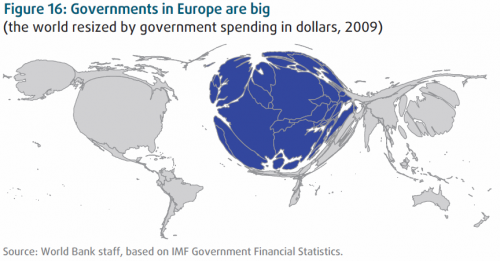
Everything You Need To Know About Europe In Three Charts

Tyler Durden

Zero Hedge, 30 January 2012

Juxtaposing Merkel's (righteous and principally correct) insistence on debt brakes and fiscal discipline with the socialist tendencies of her European (let us print) comrades is at the heart of the crisis in Europe.

Click on Image to Enlarge

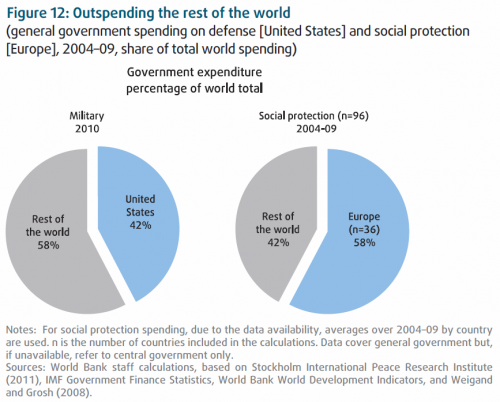
Nowhere is that more apparent than in these three charts, from the World Bank, which highlight just how large in absolute and relative terms Europe's social protection based government spending has become. This situation will only get more demanding as by 2060 almost a third of Europeans will be over 65 years old. While there was a belief that Europeans were willing to accept less growth for better growth (cleaner, smarter, kinder?), in order to meet the needs of an increasingly heavy ‘social' burden, government debt brakes will clearly have to be unhitched further, no matter what Merkel demands (increasing tensions), or the ‘new growth model' that is heralded but not yet substantive will have to be a miracle.


Click on Image to Enlarge

World Bank: THE PRECIPITATE PROMISE OF SOCIAL PROTECTION

Europe will have to make big changes in how it organizes labor and government. The reasons are becoming ever more obvious: the labor force is shrinking, societies are aging, social security is already a large part of government spending, and fiscal deficits and public debt are often already onerous.

In dealing with government spending, deficits, and debt, it is sensible to start by asking whether European governments are too big; that is, whether they spend too much. They are obviously bigger than their peers. In the EU15, governments spent 50 percent of GDP in 2009; in much of the rest of Europe, this share was about 45 percent—versus less than 40 percent in the United States and Japan, 33 percent in Latin America, and about 25 percent in emerging East Asia. A map of the world resized to reflect government spending instead of land area shows how Europe might look to outsiders (figure 16 below).

Read rest of article, see additional chart.

Phi Beta Iota:  Three themes jump out.  First, governments are too big, will fail, the era of small government leveraging new tools and new ways and new mindsets is emergent.  Second, the US overspends on the military and Europe overspends on social protection–both of these are culturally-insulated forms of corruption.  Third, the Industrial Era model of making decisions and allocating resources is no longer affordable and needs to be abandoned.  Assuming that national government refuse to heal themselves, we see local and state jurisdictions becoming very aggressive about resilience and sustainability, to the point of nullifying national regulations and if necessary declaring secession.  It is noteworthy that those governments that refused to bail out the banks and instead turned to their public for common sense solutions, are now the strongest governments.

Pierre Levy: Open-Science Movement Catches Fire

Advanced Cyber/IO, Collective Intelligence, Cultural Intelligence
0Shares
Pierre Levy

Researchers revolt against Elsiever

Testify: The Open-Science Movement Catches Fire

David Dobbs

WIRED, 30 January 2012

For years, the open science movement has sought to light a fire about the “closed” journal-publication system. In the last few weeks their efforts seemed to have ignited a broader flame, driven mainly, it seems, by the revelation that one of the most resented publishers, Elsevier, was backing the Research Works Act — some tomfoolery I noted in Congress Considers Paywalling Science You Already Paid For, on January 6. Now, 24 days later, scientists are pledging by the hundred to not cooperate with Elsevier in any way — refusing to publish in its journals,  referee its papers, or do the editorial work that researchers have been supplying to journals without charge for decades — and the rebellion is repeatedly reaching the pages of the New York Times and Forbes.

In my feature I speculated whether librarians who would eventually lead the charge. But Jason Hoyt, then of Mendeley and now of OpenRePub, seemed to have it closer: the revolution awaited only the researchers. In what is easily the biggest surge the open-science movement has ever put on, a growing list of researchers is publicly pledging against Elsevier. At The Cost of Knowledge, a site created this purpose, there were 1400 signatories last night, and when I woke today at 5 a.m., over 1600. The thing seems to be snowballing. Some have ached to take action for years. Others are newly radicalized. Together, their stated reasons form a sort of first-person dramatization of the issues I explored in “Free Science.” A skim through their testiomony (below the jump here) is an education in why the call for open science is going mainstream:

Read full article.

Phi Beta Iota:  This is of course the whole point of creating the World Brain and Global Game, to achieve precisely the efficiencies and zero resistance to multinational information-sharing and sense-making that we have been advocating since 1988 in various forms, since 1995 in Smart Nation and World Brain forms.  Open Government, Open Economy, Open Society — it is all coming as a tsunami of cultural change.

See Also:

The Open Source Everything Manifesto: Transparency, Truth, & Trust (Evolver Editions, June 2012)