Review: STOP, THIEF! The Commons, Enclosures, and Resistance

5 Star, America (Founders, Current Situation), Asymmetric, Cyber, Hacking, Odd War, Atrocities & Genocide, Capitalism (Good & Bad), Civil Society, Complexity & Resilience, Consciousness & Social IQ, Corruption, Crime (Corporate), Crime (Government), Culture, Research, Economics, Empire, Sorrows, Hubris, Blowback, Environment (Problems), History, Insurgency & Revolution, Intelligence (Collective & Quantum), Intelligence (Wealth of Networks), Justice (Failure, Reform), Nature, Diet, Memetics, Design, Peace, Poverty, & Middle Class, Philosophy, Politics, Power (Pathologies & Utilization), Priorities, Public Administration, Survival & Sustainment, True Cost & Toxicity, Values, Ethics, Sustainable Evolution, Voices Lost (Indigenous, Gender, Poor, Marginalized), War & Face of Battle, Water, Energy, Oil, Scarcity
Amazon Page
Amazon Page

Peter Linebaugh

5.0 out of 5 stars David Bollier's Review is Better, This Is My Attempt, April 21, 2014

I was very impressed by David Bollier's review of this book at his web site (look for < “Stop, Thief!” – Peter Linebaugh's New Collection of Essays > and am encouraging him to port that excellent review here to Amazon. Indeed, after working my way through the book myself, I consider myself unable to do proper justice to this deep work that integrates history, poetry, political economy, anthropology, and sociology among other disciplines. Hence I hope others will write substantive summary reviews and I again recommend Bollier's review above.

Three thoughts keep recurring as I went through this book of original current essays and presentations:

01 Holy Cow. This guy is DEEP and BROAD in terms of arcane as well as popular sources, delving down into little known poems, essays, public statements, etcetera. This book is the one book version of the Durant's Story of Civilization applied to one topic, the commons.

02 Holy Cow. This is what my top political science professor was trying to explain when I was in college in 1970-1974 – yes, a half century ago — and I was just not smart enough, patient enough, to appreciate it.

03 Holy Cow. This book is not just subversive, it does a magnificent job of head slapping every politician, economists, talking head, and other pretender who presumes to talk about public welfare without for one instant understanding that wages are a form of slavery and disconnection of humanity from everything else. Lionel Tiger makes related points in The Manufacture of Evil: Ethics, Evolution and the Industrial System but this book — if you focus and do not get lost in the poetry and minutia of exemplar citation — beats the commons versus capitalism drum along every possible note on the musical scale.

Among my high-level notes:

Continue reading “Review: STOP, THIEF! The Commons, Enclosures, and Resistance”

Review (Guest): Governing the Commons – The Evolution of Institutions for Collective Action

5 Star, Best Practices in Management, Civil Society, Complexity & Resilience, Consciousness & Social IQ, Culture, Research, Decision-Making & Decision-Support, Democracy, Economics, Environment (Solutions), History, Intelligence (Collective & Quantum), Intelligence (Public), Intelligence (Wealth of Networks), Nature, Diet, Memetics, Design, Survival & Sustainment, Values, Ethics, Sustainable Evolution, Voices Lost (Indigenous, Gender, Poor, Marginalized)
Amazon Page
Amazon Page

Elinor Ostrom

4.0 out of 5 stars Addressing the Collective Action Problem August 2, 2007

By Matthew P. Arsenault

Ostrom attempts to refute the belief that only through state and or market-centered controls can commonly pooled resources (CPRs) be effectively governed. Ostrom writes, “Communities of individuals have relied on institutions resembling neither the state nor the market to govern some resource systems with reasonable degrees of success over long periods of time” (p. 1). Governing the Commons sets out to discover why some groups are able to effectively govern and manage CPRs and other groups fail. She tries to identify both the internal and external factors “that can impede or enhance the capabilities of individuals to use and govern CPRs.”

The first section of the book examines both state-controlled and privatization property rights regimes, and illustrates failures in both regimes; namely, that central authorities often fail to have complete accuracy of information, have only limited monitoring capabilities, and possess a weak sanctioning reliability. As such, a centralized governing body may actually govern the commons inaccurately and make a bad situation worse. In the case of privatized property rights regimes, Ostrom illustrates two main points: 1) it assumes that property is homogenous and any division of property will be equitable; and 2) privatization will not work with non-stationary property (fisheries, for example).

Continue reading “Review (Guest): Governing the Commons – The Evolution of Institutions for Collective Action”

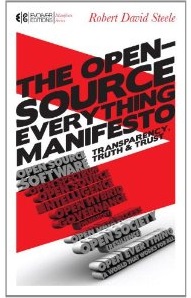
Review (Guest): The Open Source Everything Manifesto at Spirituality Today

4 Star, Best Practices in Management, Change & Innovation, Civil Society, Complexity & Resilience, Consciousness & Social IQ, Decision-Making & Decision-Support, Democracy, Economics, Education (General), Environment (Solutions), Future, Information Society, Information Technology, Intelligence (Collective & Quantum), Intelligence (Commercial), Intelligence (Government/Secret), Intelligence (Public), Intelligence (Spiritual), Intelligence (Wealth of Networks), Justice (Failure, Reform), Leadership, Nature, Diet, Memetics, Design, Peace, Poverty, & Middle Class, Philosophy, Politics, Priorities, Public Administration, Stabilization & Reconstruction, Strategy, Survival & Sustainment, Technology (Bio-Mimicry, Clean), True Cost & Toxicity, Truth & Reconciliation, Values, Ethics, Sustainable Evolution
Amazon Page
Amazon Page

The Open-Source Everything Manifesto by Robert David Steele

The Open-Source Everything Manifesto is a distillation of author, strategist, analyst, and reformer Robert David Steele life's work: the transition from top-down secret command and control to a world of bottom-up, consensual, collective decision-making as a means to solve the major crises facing our world today.

The book is intended to be a catalyst for citizen dialog and deliberation, and for inspiring the continued evolution of a nation in which all citizens realize our shared aspiration of direct democracy—informed participatory democracy. Open-Source Everything is a cultural and philosophical concept that is essential to creating a prosperous world at peace, a world that works for one hundred percent of humanity.

The future of intelligence is not secret, not federal, and not expensive. It is about transparency, truth, and trust among our local to global collective. Only “open” is scalable.

As we strive to recover from the closed world corruption and secrecy that has enabled massive fraud within governments, banks, corporations, and even non-profits and universities, this timely book is a manifesto for liberation—not just open technology, but open everything.

Our Review

The term Open Source refers to universal access to a product or services core design or primary features. Without Open Source there would be no Internet in the way that we currently enjoy it for it is in digital publishing and information sharing that Open Source has been such a powerful force for change.

Continue reading “Review (Guest): The Open Source Everything Manifesto at Spirituality Today”

Review: The Politics of Haunting and Memory in International Relations

5 Star, Asymmetric, Cyber, Hacking, Odd War, Atrocities & Genocide, Consciousness & Social IQ, Culture, Research, Intelligence (Public), Intelligence (Spiritual), Justice (Failure, Reform), Truth & Reconciliation, Voices Lost (Indigenous, Gender, Poor, Marginalized)
Amazon Page
Amazon Page

Jessica Auchter

5.0 out of 5 stars Quite Extraordinary — a Pioneering Book — Builds on Others But Original and Compelling It Its Own Right, April 27, 2014

I took an interest in books on trauma and dealing with refugees a month or so ago, and this is one of the books that I included in my list easily found online Worth a Look: Books on War and Torture Victims, Asylum and Refugee Trauma. The other book I have reviewed from that list is Peter Levine's In an Unspoken Voice: How the Body Releases Trauma and Restores Goodness.

The author has rendered an extraordinary work. While building on the works of others this is a pioneering book that helps open the door toward holding states [and I would add corporations] accountable for the dead [and I would add amputees]. I found this book compelling, engaging, and original.

The bulk of the book and the bulk of the value is in the literature review and the author's conclusions. Three case studies are provided — on Rwanda where the state “erased” the victims; on illigal immigrants who die on US soil or are “exiled” into non-person status; and on 9/11 where the state and its corporate controlled media “excised” all photographs of the vicitms, particularly those who jumped to their deaths from the towers.

I've read a lot of academic books and dissertations, and found that the manner in which this author reviewed the works of others, and personalized that review by artful use of the names of the authors being cited in text, was for me a most professional and yet also humanizing and engaging exercise.

This is a very subversive book is you have the courage to actually contemplate holding a state accountable for both those it has killed or allowed to be killed by legalized crime and elective war and deliberate non-intervention; while also contemplating how the state relegates so many to the status of “virtual dead.” At root, this book opens a super-highway into the heart of the deep state (I would add deep corporation including those that practice eugenics), one that could inspire the living to challenge the faux legitimacy of states that are in the view of one author, Greogry Sams, long overdue for deconstruction, see his just released book that I have ordered and will review, The State Is Out of Date: We Can Do It Better.

Continue reading “Review: The Politics of Haunting and Memory in International Relations”

Review (Guest): Trying Not to Try – The Art and Science of Spontaneity

5 Star, Consciousness & Social IQ, Culture, Research, Nature, Diet, Memetics, Design, Philosophy
Amazon Page
Amazon Page

Edward Slingerland

5.0 out of 5 stars Paradigm shifting look at Csikszenmihaly's concept of flow, March 23, 2014
By Just Me

When I discovered Mihaly Csikszentmihaly's book Flow, about 10 years ago, I recognized that he was talking about a concept that I had experienced many times, that was important in my life, and that I craved. Learning about flow has helped me, but has also provided frustrations, both because of difficulties and because of a lack of greater meaning. Slingerland's Trying Not To Try offers the solution to these problems. Slingerland compares the Western concept of flow to the Eastern concepts of wu-wei and de. Wu-wei is “the dynamic, effortless, and unselfconscious state of mind of a person who is optimally active and effective”; de is a charismatic power “that others can detect, and it serves as an outward signal that one is in wu-wei.”

Slingerland looks at early Eastern philosophy and at modern science and sees how the connections between the two explain the how and why of wu-wei and de. As Slingerland says, “A growing literature in psychology and neuroscience suggests that these (early Eastern) thinkers had a much more accurate picture of how people really think and behave than we find in recent Western philosophy or religious thought and that early Chinese debates about how to attain wu-wei reflect real tensions built into the human brain. Scientists are beginning to better appreciate the role that “fast and frugal” unconscious thinking plays in everyday human life and now have a clearer sense of why spontaneity and effectiveness hang together.” Evolutionary psychology is very helpful in explaining the “why”, which was very helpful in solving the problems that the concept of flow presented to me. Slingerland explains that, it “gives us insight into why wu-wei is so pleasant for the individual and attractive to others… It feels good to be in wu-wei because a whole slew of tasks simply can't be performed by our plodding, conscious minds — we need to unleash the power of our fast, unconscious processes in order to get them done. Moreover, we are attracted to people in wu-wei because we trust the automatic, unconscious mind. We have a very strong intuition — increasingly confirmed by work in cognitive science — that the conscious, verbal mind is often a sneaky, conniving liar, whereas spontaneous, unselfconscious gestures are reliable indicators of what's really going on inside another person.”

Continue reading “Review (Guest): Trying Not to Try – The Art and Science of Spontaneity”

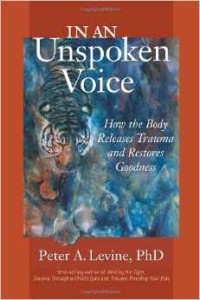
Review: In An Unspoken Voice – How the Body Releases Trauma and Restores Goodness

5 Star, Consciousness & Social IQ, Culture, Research, Disaster Relief, Humanitarian Assistance, Intelligence (Public), Intelligence (Spiritual), Nature, Diet, Memetics, Design, Peace, Poverty, & Middle Class, Stabilization & Reconstruction, Truth & Reconciliation, Values, Ethics, Sustainable Evolution, Voices Lost (Indigenous, Gender, Poor, Marginalized), War & Face of Battle
Amazon Page
Amazon Page

Peter A. Levine

5.0 out of 5 stars Demands Careful Reading, A Capstone Book that Emphasizes BALANCE, April 21, 2014

I read this book at the same time as Cyntia Sue Larson's Quantum Jumps: An Extraordinary Science of Happiness and Prosperity and E. Graham Howe as edited by William Stranger, The Druid of Harley Street: The Spiritual Psychology of E. Graham Howe. In line to be read as part of this series is also Guy Muchie's The Seven Mysteries of Life: An Exploration of Science and Philosophy.

This is by no means an easy read but its bottom-line (bearing in mind that the author has been writing many books on this theme, this is the latest) is clear: Sound Mind in a Sound Body. Others would add Sound Soul and Sound Heart at well. In other words, the mind is carried in the host, the body, and the totality of the nervous system, the skeletal system, the muscle system, the bio-chemical soup system, are all critical to how well the mind functions and how well the mind — including the unconscious — heals in the aftermath of trauma.

Continue reading “Review: In An Unspoken Voice – How the Body Releases Trauma and Restores Goodness”

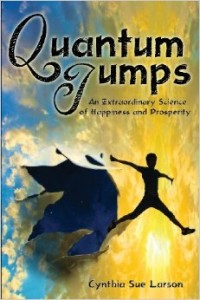
Review: Quantum Jumps – An Extraordinary Science of Happiness and Prosperity

6 Star Top 10%, Complexity & Resilience, Consciousness & Social IQ, Culture, Research, Intelligence (Spiritual), Nature, Diet, Memetics, Design
Amazon Page
Amazon Page

Cynthia Sue Larson

5.0 out of 5 stars 6 Star Mix of Consciousness and Physics – a Life-Changing Book, April 21, 2014

The author asked me to review this book, and I agreed because it comes at a good time in my 61-year long life. I have read it along with Peter Levine's In an Unspoken Voice: How the Body Releases Trauma and Restores Goodness and The Druid of Harley Street: The Spiritual Psychology of E. Graham Howe. Waiting to be read in this series is The Seven Mysteries of Life: An Exploration of Science and Philosophy.

Among them all this is the 6 star special (my top 10% acorss 1,900+ non-fiction reviews), the easiest to grasp, the most meaningful for those seeking to make the leap from being trapped in a world controlled by a malevolent 1%, to a world in which we have a greater effect on ourselves and our community.

My past reading lists, all leading to Amazon, in this general area are easily found by searching for

Worth a Look: Book Reviews on Conscious, Evolutionary, Integral Activism & Goodness

Worth a Look: Book Reviews on Evolutionary Dynamics

What most impressed me about this book was its deep appreciation of real-world physics — it was not until the end of the book that I realized that the author was trained in this discipline and has a very healthy bibliography in that discipline included in the book. This is NOT a “kum-ba-ya” book. Indeed, physics is just now coming to grips with the reality that consciousness matters (pun intended), see the below books

Continue reading “Review: Quantum Jumps – An Extraordinary Science of Happiness and Prosperity”