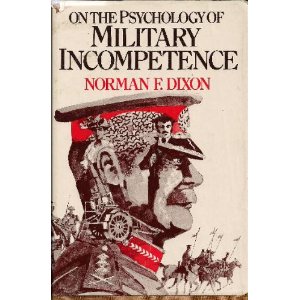
Review: On the Psychology of Military Incompetence

5 Star, Complexity & Catastrophe, Corruption, Culture, Research, Empire, Sorrows, Hubris, Blowback, Force Structure (Military), Impeachment & Treason, Intelligence (Government/Secret), Military & Pentagon Power, Misinformation & Propaganda, Power (Pathologies & Utilization), Public Administration, Secrecy & Politics of Secrecy, Threats (Emerging & Perennial)
Amazon Page
Norman Dixon
5.0 out of 5 stars Absolutely a Core Reference, August 21, 2009

I am so very glad to see this book at least available from some sellers in second-hand form. I still have my orginal hard cover from 1976 and took it down from my military shelf to appreciate it once more. I urge the publisher to re-print this book, and I would be deeply honored to be asked to write a foreword to the next edition. Norman Dixon has made a signal contribution that will long out-live all of us.

Although I despise Amazon for pre-emptorily deleting over 350 of my shared images to get rid of 12 copies of Bush-Obama sharing a face, I think so highly of this book that I have taken the time to scan and load my own original book cover. You can find all of my uncensored work at the Public Intelligence Blog.

This is nothing less than an essential reference in the leadership arena, and particularly in the national security arena. The author is a deeply original speaker of truth to power, and his work on the characteristics of incompetence, his chart on the role of “bull,” his discussions of the reactions to criticisms, the concept of “efficiency” in the armed forces, and his examination of both the kinds of relationships and the interplay among the authoritarian personality and “group-think” are all very very important.

Most of our military officers (in the USA) have for decades forgotten that they swear an Oath to defend the Constitution against all enemies foreign and domestic, and instead they translate that oath into blind obedience to the chian of command, no matter how illegal, idiotic, or illogical those orders might be.

See also:
The Rules of the Game: Jutland and British Naval Command
Secrets: A Memoir of Vietnam and the Pentagon Papers
None So Blind: A Personal Account of the Intelligence Failure in Vietnam
Who the Hell Are We Fighting?: The Story of Sam Adams and the Vietnam Intelligence Wars
War is a Racket: The Antiwar Classic by America's Most Decorated Soldier
The Fifty-Year Wound: How America's Cold War Victory Has Shaped Our World
Wilson's Ghost: Reducing the Risk of Conflict, Killing, and Catastrophe in the 21st Century
Weapons of Mass Deception: The Uses of Propaganda in Bush's War on Iraq
DVD: The Fog of War: Lessons from the Life of Robert S. McNamara
DVD: Why We Fight

Vote and/or Comment on Review

Review: Winning the Long War: Retaking the Offensive against Radical Islam

5 Star, Complexity & Catastrophe, Congress (Failure, Reform), Democracy, Diplomacy, Empire, Sorrows, Hubris, Blowback, Executive (Partisan Failure, Reform), Information Operations, Insurgency & Revolution, Intelligence (Government/Secret), Intelligence (Public), Military & Pentagon Power, Misinformation & Propaganda, Peace, Poverty, & Middle Class, Philosophy, Public Administration, Religion & Politics of Religion, Secrecy & Politics of Secrecy, Strategy, Threats (Emerging & Perennial), Values, Ethics, Sustainable Evolution, War & Face of Battle, Water, Energy, Oil, Scarcity
Amazon Page
Amazon Page

First, Understand the Enemy Within

July 25, 2009

Ilan Berman

I love the book, not least because it reiterates the Secretary of Defense view that the military cannot win this Long War alone.

What this book does NOT address is the raw fact that we are our own worst enemy, and that as long as we make policy based on delusional fantasies combined with rapid profiteering mandates from Goldman Sachs and Wall Street, as long as we lack a strategic analytic model, and as long as we are completely opposed to actually creating a prosperous world at peace, then the USA is destined for self-immolation.

Buy the book. Also consider:
Winning the Long War: Lessons from the Cold War for Defeating Terrorism and Preserving Freedom
Unfolding the Future of the Long War: Motivations, Prospects, and Implications for the U.s. Army

HOWEVER, if you recognize as I do that those in power are completely divorced from reality, having become “like morons” as Daniel Ellsberg lectured Henry Kissinger in Secrets: A Memoir of Vietnam and the Pentagon Papers, and that both Congress and the White House consist of good people trapped in a bad system that robs each and every one of them of their integrity, then no happy ending is possible.

I have posted my book Election 2008: Lipstick on the Pig (Substance of Governance; Legitimate Grievances; Candidates on the Issues; Balanced Budget 101; Call to Arms: Fund We Not Them; Annotated Bibliography) online, the Annotated Bibliogrpahy will lead those who wish to connect to reality to over 500 non-fiction reviews here at Amazon.

Books I specifically recommend for anyone who can actually talk to Obama about reconnecting with both reality and the 70% of eligible voters that did NOT vote for his well-greased win:
The Unconquerable World: Power, Nonviolence and the Will of the People
The Sorrows of Empire: Militarism, Secrecy, and the End of the Republic (The American Empire Project)
The Eagle's Shadow: Why America Fascinates and Infuriates the World
War is a Racket: The Antiwar Classic by America's Most Decorated Soldier
Running on Empty: How the Democratic and Republican Parties Are Bankrupting Our Future and What Americans Can Do About It
The Broken Branch: How Congress Is Failing America and How to Get It Back on Track (Institutions of American Democracy)

The power and common sense of the Average American (see the book by that title, I am out of authorized links) can still be brought to bear, but first we have to stop this nonsense of thinking that if we only have the right strategy, we can evil and force not just the emerging powers, but Brazil, China, India, Indonesia, Iran, Russia, Venezuela, and Wild Cards like the Congo, Malaysia, Pakistan, South Africa, and Turkey into their “role” as playthings of the American Empire.

Please. We have gone from a village idiot to a major domo that gives good theater, and books like this are still being written? Get a grip!

Phi Beta Iota, the new honour society committed to public intelligence in the public interest, is now publishing the free online Journal of Public Intelligence. There are no costs or qualifications save one: have a brain and use it in the public interest.

Vote on Review
Vote on Review

Click Here to Vote on Review at Amazon,

on Cover Above to Buy or Read Other Reviews,

I Respond to Comments Here or There

Review: GIS for Decision Support and Public Policy Making

5 Star, Best Practices in Management, Change & Innovation, Complexity & Resilience, Decision-Making & Decision-Support, Disaster Relief, Games, Models, & Simulations, Geography & Mapping, Geospatial, History, Humanitarian Assistance, Information Operations, Information Society, Information Technology, Intelligence (Government/Secret), Intelligence (Public), Peace, Poverty, & Middle Class, Stabilization & Reconstruction, Strategy, True Cost & Toxicity, Truth & Reconciliation, Values, Ethics, Sustainable Evolution, Voices Lost (Indigenous, Gender, Poor, Marginalized), War & Face of Battle, Water, Energy, Oil, Scarcity

Amazon Page
Amazon Page

ESRI Sales Material, Excellent Price, Recommended,

July 20, 2009
Christopher Thomas and Nancy Humenik-Sappington
As a publisher who is also an author, I continue to be outraged by the prices being charged for “trade” publications. This book is properly-priced–other books on GIS I would have bought are priced at three to four times their actual value, thus preventing the circulation of that knowledge. Those publishers that abuse authors and readers refuse to respect the reality that affordably priced books are essential to the dissemination of knowledge and the perpetuation of the publishing industry.

The book loses one star for refusing to address Google Earth and elements of the Google offering in this industry space. While Google is predatory and now under investigation by the anti-trust division of the Department of Justice, to ignore Google and its implications for cloud management of data in geospatial, time, and other cross- cutting contests, is the equivalent of poking one eye out to avoid seeing an approaching threat.

Having said that, I found this book from ESRI charming, useful, and I recommend it very highly, not least because it is properly priced and very well presented. Potential clients of ESRI can no doubt get bulk deliver of this volume for free.

Return on Investment factors that ESRI highlights up front include:
+ Cost and times savings
+ Increased efficiency, accuracy, productivity of existing resources
+ Revenue generation
+ Enhanced communications and collaboration
+ Automated workflows
+ More efficient allocation of new resources
+ Improved access to information.

The book consists of very easy-to-read and very well-illustrated small case studies, most previously published in Government Matters, which appears to be a journal (there are a number listed by that title).

Here are the highlights of this book for me personally:

+ Allows for PUBLIC visualization of complex data
+ Framework for “seeing” historical data and trends
+ Value of map-based dialog [rather than myth-based assertions]
+ Allows for the visualization of competing perspectives past and future
+ Illuminated land population dynamics, I especially like being able to see “per capita” calculations in visual form, especially when per capita can also be sliced by age, sex, income, religion, race, and so on.
+ Mapping derelict vessels underwater is not just a safety function, but opens the way for volunteer salvage and demolition
+ GROWS organically by attracting new data contributors who can “see” the added value of contributing their data and then being able to see their data and everyone else's data in geospatial terms. This is a POWERFUL incentive for information-sharing, which more often than not receives lip service. GIS for me is the “key” to realizing sharing across all boundaries while also protecting individual privacy
+ Shows “pockets” of need by leveraging data gaps in relation to known addresses (e.g. immunizations, beyond 5 minute fire response, etc.)'
+ Gives real meaning to “Intelligence Preparation of the Battlefield (IPB)” and–not in this book–offers enormous potential if combined with a RapidSMS web database that can received text messages from hundreds of thousands of individuals across a region
+ Eliminates the time-energy cost of data collection in hard copy and processing of the individual pages into an aggregate database.

The book discusses GIS utility in the routing of hazardous materials, but avoids the more explosive (pun intended) value of GIS in showing the public as well as government officials where all the HAZMAT is complacently stored now. For a solid sense of the awaiting catastrophe, see my review of The Next Catastrophe: Reducing Our Vulnerabilities to Natural, Industrial, and Terrorist Disasters.

The book also avoids any discussion of the urgency as well as the value of GIS in tracking and reducing natural resource consumption (e.g. water usage visible to all house by house), and the enormous importance of rapidly making it possible for any and all organizations to channel their data into shared GIS-based aggregations. For a sense of World Brain as EarthGame, see my chapter in Collective Intelligence: Creating a Prosperous World at Peace the chapter is also free online at the OSS.Net, Inc. website forward slash CIB.

This book, 189 pages of full color, is a righteous useful offering. I would encourage ESRI to become the GIS publisher of choice, buy out the titles that I could not afford, and enter the business of affordable aggregate publishing in the GIS field. Other titles by ESRI on GIS:
Measuring Up: The Business Case for GIS
The GIS Guide for Local Government Officials
Zeroing in: Geographic Information Systems at Work in the Community

Five other cool books on data pathologies that GIS can help resolve:
The Landscape of History: How Historians Map the Past
Fog Facts : Searching for Truth in the Land of Spin (Nation Books)
Lost History: Contras, Cocaine, the Press & ‘Project Truth'
Forbidden Knowledge: From Prometheus to Pornography
The Age of Missing Information (Plume)

The latter remind me that GIS will not blossom fully until it can help the humanities deal with emotions, feelings, and perceptions across tribal and cultural boundaries. Right now, 23 years after I first worked with GIS in the Office of Information Technology at CIA, GIS is ready for the intermediate leap forward: helping multinational multiagency data sets come together. ESRI has earned deep regard from me with this book and I will approach them about a new book aimed at the UN, NGOs, corporations, and governments that wish to harmonize data and in so doing, harmonize how they spend across any given region, e.g. Africa. This will be the “master leap” for GIS, enabling the one billion rich to respond to micro-needs from the five billion poor, while also increasing the impact of aggregated orchestrated giving by an order of magnitude.

ESRI: well done!

Vote on Review
Vote on Review

Click Here to Vote on Review at Amazon,

on Cover Above to Buy or Read Other Reviews,

I Respond to Comments Here or There

Review: Analyzing Intelligence: Origins, Obstacles, and Innovations

4 Star, Intelligence (Government/Secret)

Amazon Page
Amazon Page

Of, By, and For USA Status Quo Bubbas–Essential but Very Partial

July 14, 2009
Roger Z. George
This is a very fine book, not least because of its inclusion of Jack Davis (search for <analytic tradecraft> as well as Carmen Medina (see her presentation to global audience via oss.net/LIBRARY), but in its essentials this is a book of, by, and for the status quo ante bubbas–the American bubbas, I might add.

If you are an analyst or a trainer of analysts or a manager of analysts, this is assuredly essential reading, but it perpetuates my long-standing concerns about American intelligence:

1) Lack of a strategic analytic model (see Earth Intelligence Network)

2) Lack of deep historical and multi-cultural appreciation

3) Lack of a deep understanding and necessary voice on the complete inadequacy of collection sources, the zero presence of processing and lack of desktop analytic tools, and the need for ABSOLUTE devotion to the truth, not–as is still the case, “within the reasonable bounds of dishonesty” aka “slam dunk”

4) Lack of integrity in so many ways, not least of which is the analytic abject acceptance of the false premise that the best intelligence is top secret/sensitive compartmented information–see the online CounterPunch piece on “Intelligence for the President–AND Everyone Else.”

Below are ten books I recommend as substantive complements to this book:
The Landscape of History: How Historians Map the Past
Lost History: Contras, Cocaine, the Press & ‘Project Truth'
Fog Facts : Searching for Truth in the Land of Spin (Nation Books)
Lost Promise
The Age of Missing Information (Plume)
Informing Statecraft
Bureaucratic Politics And Foreign Policy
A More Secure World: Our Shared Responsibility–Report of the Secretary-General's High-level Panel on Threats, Challenges and Change
Legacy of Ashes: The History of the CIA
The Shadow Factory: The Ultra-Secret NSA from 9/11 to the Eavesdropping on America

Vote on Review
Vote on Review

Click Here to Vote on Review at Amazon,

on Cover Above to Buy or Read Other Reviews,

I Respond to Comments Here or There

Review: Imperial Secrets–Remapping the Mind of Empire

5 Star, Intelligence (Government/Secret)
Imperial Intelligence
Amazon Page

Delightful evidence of gravitas, provocative and refreshing,

July 14, 2009
by Patrick Kelley
Free PDF
Free PDF
Review or Download Free Copy
From National Defense Intelligence College
Kudos to NDIC for making this book available free online, simply search for the title. The book is easily downloadable and easily readable, and as much as I would have preferred to buy, mark up, and keep the book in hard-copy, the online availability permits me to both read and praise.

The book should NOT be priced above $34.95 and ideally at $24.95. Either NDIC is being cheated by its printer or it is not being thoughtful about making knowledge easily disseminable in the preferred printed form (hand eye coordination, marginal notes, sharing, etcetera). My printer would do this book for under $5 a copy.

I like this book, very much. The author studies the relationship between empire and knowledge, and specifically addresses the “information anxiety” and related intelligence (decision-support) pathologies associated with empire.

The following quote, on page 69, is quite consistent with all that I have both read and written:

“We rely too much on others to bring information to us, and too often don't understand what is reported back because we do not understand the context of what we are told.”

He cites James Baker and Lee Hamilton [Iraq Study Report], page 94.

At each turn the author recognizes that empires are militarily strong and can impose their own “rule of law,” but empires are NOT inherently capable of understanding exotic cultures and socio-economic domains.

The author's discussion of alternative renderings of information, and the importance of translation of meaning vice literal translation, is most interesting. His judgment of what we do now that passes for cultural intelligence is consistent with my own–checklists that apply an old process to a profoundly complex target, producing nothing more than facile templates.

I am much taken with his observation, on page 83

“Whether in the case of classical historiography or Ottoman tax administration, the idea of what constitutes knowledge changes depending on the contexts of both consumers and producers–eliminating these differences in some form of epistemological Esperanto may produce consensus and clarity, but it also sheds the information embedded in those differences.”

In the author's own words, words that describe our intelligence community from the time Ellsberg talked to Kissinger to my own depictions these past 15 years, on page 97:

“If power corrupts absolutely, it also tends to isolate completely–twin tendencies any executive authority risks as it ascends to the heights of imperial power. Bureaucracies rise in tandem with that isolation, providing the intellectual equivalent of walls and gates; but subverting that intellectual structure by act of will can prove nearly as impossible as escaping from the physical walls for reasons of status or security.”

This elegant study brought me back to Michael Foucault {{Archeology of Knowledge]]

The discussion of the British approach to information with respect to its governance of India is especially fascinating for me, and in particular the discussion of the British valuation and exploitation of past history to mask or justify present courses of action and future plans; and the British-US today error in assuming that imperial time was progressive and all other cultural times were not–I observe myself that China and Iran in their own way are both showing US and UK time to be at odds with strategic reality and sustainment.

It is about page 115 where the author briefly touches on warning and observes that the British did not lack for warning, they lacked for understanding. I hope those reading this review might care to look up my most recent article, “Perhaps We Should Have Shouted: A Twenty-Year Retrospective” (OSS.Net, Spring 2009).

The author is fascinating on education attacking authority, and on the displacement of traditional education having the negative side effect of displacing local elites previously well provided for by the traditional system.

The author segues into a reiteration of his key theme, to wit, to wit, intelligence with respect to the “other” is less a matter of specific fact, but rather more a matter of “negotiating” what truth means and defining what “knowing” actually encompasses.

I enjoy the author's integrated discussion of the failure of empire to understand that its behavior is a form of communication that is all too often very negative; that cultural understanding is about vastly more than compiling dates and names; and the intensity, messiness, and in some cases sordid nature of both the gathering and the explaining. The costs–and the benefits–of “going native” only to see t he West with native disdain and to be detested by one's own colleagues for having “gone over” is something I understand all too well from being in those circles where loyalty to the chain of command takes precedence over both the truth, and our oath to the Constitution.

One recurring theme that intrigues me in this book is that of needing to collect intelligence from different social levels–a network for the masters, another for the slaves. This is absolutely fascinating, since I and others know from experience that CIA does cocktail parties, not gutters. I can really see the value of a dedicated non-official cover cadre that specializes in the servant class.

I will end with a strong appreciation for the author's conclusion, and urge wide dissemination of this volume across the schoolhouses and into the international fellows program for incremental enhancement.

Page 184: “Where information is rich, and open to interpretation through sophisticated and polyvalent reading–we have knowledge. Where information grows and expands with organic profligacy while institutions of understanding grow increasingly rigid and formal, we have information overload, the Tower of Babel.”

Page 194: “The real secrets are the things we aren't looking for.”

The author's conclusion is almost spiritual, rich, and the bibliography a wonder. There are a number of areas where I could be critical, but not here, not now. This is a righteous work, and both the author and the NDIC research arm can be very proud of what has been created for all of us to consider.

Other books for the intelligence professional that wishes to go beyond “of by and for the bubbas”:
Strategic Intelligence & Statecraft: Selected Essays (Brassey's Intelligence and National Security Library)
The Landscape of History: How Historians Map the Past
Fog Facts : Searching for Truth in the Land of Spin (Nation Books)
The Age of Missing Information (Plume)
Forbidden Knowledge: From Prometheus to Pornography

Now the following three books I have not read, but the author has turned my attention to a slice of literature I have never before explored, that of empire intelligence (and non-intelligence):
Empires of Intelligence: Security Services and Colonial Disorder after 1914
Empire and Information: Intelligence Gathering and Social Communication in India, 1780-1870 (Cambridge Studies in Indian History and Society)
The Armies of Ignorance The Rise of the American Intelligence Empire

Finally, two books covering policy “rules of the game” anti-thetical to “hearing” intelligence or common sense:
Bureaucratic Politics And Foreign Policy
The Rules of the Game: Jutland and British Naval Command

AA Mind the Gap
Vote on Review

Review: Catastrophe

America (Founders, Current Situation), Capitalism (Good & Bad), Complexity & Catastrophe, Crime (Corporate), Crime (Government), Democracy, Empire, Sorrows, Hubris, Blowback, Impeachment & Treason, Intelligence (Government/Secret), Intelligence (Public)

Amazon Page
Amazon Page

Dick Morris is part of the circus–Wall Street owns it and him,

July 14, 2009
Dick Morris

Neophytes argue about facts, journeymen argue about models, and masters discuss the assumptions underlying the models.

This book assumes the President has power, which most of us who are students of America, from Buckminster Fuller on, have recognized is not the case. We've gone from a village idiot to a major domo, and the only constants are three:

1) Wall Street and Goldman Sachs specifically continues to run and manipulate the US Treasury against the public interest.

2) Congress continues to abdicate its responsibility to its constituencies and the Constitution

3) The bulk of the American people remain uninformed sheep.

The ten books below are intended for those of you that want to move beyond Dick Morris as the classic comic book version of the truth, and into the deeper truth that should inspire Constitutionally-valid actions to restore the sovereignty of We the People of the United STATES of America. You cannot fix what you do not understand. Obama is a tool, not the problem. If Obama were willing to break free of Wall Street and embrace the 70% of America that did not vote for him, he could actually become the George Washington of this century if not this millenium.

There is nothing wrong with America that cannot be fixed by restoring the Constitution and the sovereignty of We the People. The Electoral Reform Act of 2009, blowing open the crooked two-party system to Independents, Greens, Reforms, and Libertarians, and all others, is the ONLY thing we need to understand and demand. Below I offer five books on each side of the future:

Grand Illusion: The Myth of Voter Choice in a Two-Party Tyranny
Running on Empty: How the Democratic and Republican Parties Are Bankrupting Our Future and What Americans Can Do About It
Breach of Trust: How Washington Turns Outsiders Into Insiders
Obama: The Postmodern Coup – Making of a Manchurian Candidate
Liar's Poker: Rising Through the Wreckage on Wall Street

The Tao of Democracy: Using Co-Intelligence to Create a World That Works for All
Society's Breakthrough!: Releasing Essential Wisdom and Virtue in All the People
All Rise: Somebodies, Nobodies, and the Politics of Dignity (BK Currents (Hardcover))
The Average American: The Extraordinary Search for the Nation's Most Ordinary Citizen
Constitutional History of Secession

The latter book makes it crystal clear–and the same is true in Canada for Quebec and others–that secession is a legal, non-violent, absolute right of each of the United STATES of America. Wall Street is literally creating a “fire sale” in the USA while moving all of its assets into foreign currencies. Just how stupid do We the People have to be?

Dick Morris is a good man, but he is a clown in this circus, and if all do not focus right now on the misbehavior of the government at large, violating the Constitution every day, not acting in the public interest as We the People would define it, then the USA will break up as the Soviet Union did, within the decade.

Vote on Review
Vote on Review

Click Here to Vote on Review at Amazon,

on Cover Above to Buy or Read Other Reviews,

I Respond to Comments Here or There

Review: Organizational Intelligence (Knowledge and Policy in Government and Industry)

5 Star, Decision-Making & Decision-Support, Information Operations, Intelligence (Commercial), Intelligence (Government/Secret), Intelligence (Public)
Amazon Page
Amazon Page

Foundation Work, April 2, 2008

Harold L. Wilensky

UPDATED 28 March 2014 to add a few key points.

This gem is so valuable to me that when I could not find a copy for sale (this was way back before Amazon made it easy), I made a personal copy.

This is a foundation work for organizational intelligence, which now includes four converging streams: Open Source Intelligence (OSINT), Collective Intelligence, Peace Intelligence, and Commercial Intelligence.

I would like very much to see this re-published, and would be glad to contribute a preface from a commercial point of view while Mark Tovey, editor of the forthcoming book on Collective Intelligence: Creating a Prosperous World at Peace, does the academic preface.

This is a “must have” reference for anyone thinking about group IQ, smart mobs, smart nations, smart corporations, etcetera.

A few key points, with many others not itemized:

01 Explores how knowledge shapes (or does not shape) policy in both governent and industry

02 Information converted into intelligence integrates clear, timely, reliable, valid, adequate, and wide-ranging.

03 Intelligence failures stem in part from hierarchy (which conceals and misinterprets), specialization, rivalry, and other institutional dysfuntionalities.

04 There remains a great shortage of generalists able to select, discriminate, and integrate.

05 Information technology elevates the hard variables, represses the soft variables

06 Those at the top are out of touch; good judgment is rare, decisions are not fully informed nor deliberative.

The New Craft of Intelligence: Personal, Public, & Political–Citizen's Action Handbook for Fighting Terrorism, Genocide, Disease, Toxic Bombs, & Corruption
Business Blindspots: Replacing Your Company's Entrenched and Outdated Myths, Beliefs and Assumptions With the Realities of Today's Markets
Group Genius: The Creative Power of Collaboration
The Tao of Democracy: Using Co-Intelligence to Create a World That Works for All
The World Cafe: Shaping Our Futures Through Conversations That Matter
Society's Breakthrough!: Releasing Essential Wisdom and Virtue in All the People
One from Many: VISA and the Rise of Chaordic Organization
The Wealth of Networks: How Social Production Transforms Markets and Freedom
Collective Intelligence: Creating a Prosperous World at Peace