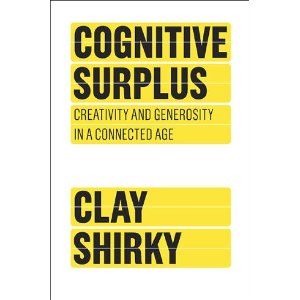
Review (Guest): Cognitive Surplus–Creativity and Generosity in a Connected Age

6 Star Top 10%, Change & Innovation, Civil Society, Complexity & Resilience, Consciousness & Social IQ, Culture, Research, Democracy, Economics, Education (General), Environment (Solutions), Future, Information Society, Intelligence (Collective & Quantum), Intelligence (Public), Intelligence (Wealth of Networks), Nature, Diet, Memetics, Design, Values, Ethics, Sustainable Evolution
Amazon Page

Recommended by Dr. Kent Myers.  Eleveated by Phi Beta Iota to 6 Stars and Beyond because this book is much more readable than Wealth of Networks and captures the essence for the general reader in a manner more likely to accelerate understanding and transformation.

5.0 out of 5 stars Recommended as THE book to understand the fundamentals of social media collaboration

June 27, 2010

Reviewed by M. McDonald

Clay Shirky captured the ethos of social media with his book Here comes everybody. He follows that book up with one that concentrates on the fundamentals of turning our cognitive surplus into value. Cognitive Surplus provides a compelling and clear description of the fundamentals of social media and collaboration as well providing principles that are guiding developments and innovation in this space.

There are many books out there that either describe the social media phenomenon or profess to provide a `recipe' for success. Neither of these approaches can provide you with the insight needed to effectively experiment and deploy social media for the simple reason that social media is changing too fast.

The book is organized into seven chapters that outline a complete way of thinking about social media.

Continue reading “Review (Guest): Cognitive Surplus–Creativity and Generosity in a Connected Age”
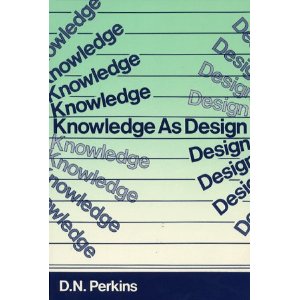
Review: Knowledge As Design

5 Star, Education (General), Information Society, Intelligence (Public), Nature, Diet, Memetics, Design, True Cost & Toxicity, Values, Ethics, Sustainable Evolution, Voices Lost (Indigenous, Gender, Poor, Marginalized)
Amazon Page

5.0 out of 5 stars Older Version of Updated Book Now Being Offered on Amazon


August 9, 2010

David Perkins

I was on the verge of buying this book when I realized that the author has a number of new books out, including Making Learning Whole: How Seven Principles of Teaching Can Transform Education, which I have bought and will review in detail shortly, as well as the following four books that I am not buying, but certainly think are on a very important path toward educational revitalization and re-invention:

Smart Schools
The Eureka Effect: The Art and Logic of Breakthrough Thinking
The The Intelligent Eye: Learning to Think by Looking at Art (Occasional Paper Series)
Outsmarting IQ: The Emerging Science of Learnable Intelligence

Continue reading “Review: Knowledge As Design”

Review: Shooting the Truth–The Rise of American Political Documentaries

6 Star Top 10%, 9-11 Truth Books & DVDs, America (Founders, Current Situation), Atlases & State of the World, Atrocities & Genocide, Banks, Fed, Money, & Concentrated Wealth, Capitalism (Good & Bad), Censorship & Denial of Access, Communications, Consciousness & Social IQ, Corruption, Culture, DVD - Light, Culture, Research, Democracy, Economics, Education (General), Empire, Sorrows, Hubris, Blowback, History, Impeachment & Treason, Information Society, Iraq, Justice (Failure, Reform), Media, Military & Pentagon Power, Misinformation & Propaganda, Peace, Poverty, & Middle Class, Power (Pathologies & Utilization), Secrecy & Politics of Secrecy, Threats (Emerging & Perennial), Values, Ethics, Sustainable Evolution, Voices Lost (Indigenous, Gender, Poor, Marginalized), War & Face of Battle
Amazon Page

5.0 out of 5 stars Both a Tour of Substance, and an Eye Opener for Book People

July 29, 2010

James McEnteer

This is a 6 Star and Beyond book and is so categorized at Phi Beta Iota, the Public Intelligence Blog, where one can browse all 1600+ of my non-fiction reviews sorted into 98 categories and easily found with keywords–I've tried for years to get Amazon to give us this functionality and finally created it for my own work.

I was so impressed, so engaged, so absolutely educated by this author that I spent no less than four hours, and it might be as much as six, creating a table of all 120 films that he mentioned, with the directors, the year of release, and hot links. The complete list with hot links is at Phi Beta Iota, and should have been an appendix–I certainly give the list to the author should he wish to post it anywhere.

A few highlights, followed by the complete table of 120 films:

Review: Dear Hacker–Letters to the Editor of 2600

5 Star, Asymmetric, Cyber, Hacking, Odd War, Change & Innovation, Games, Models, & Simulations, Information Operations, Information Society, Information Technology, Intelligence (Collective & Quantum), Intelligence (Wealth of Networks), Philosophy, Technology (Bio-Mimicry, Clean)
Amazon Page

5.0 out of 5 stars Half of the Priceless Set

July 16, 2010

Emmanuel Goldstein

I've been browsing this marvelous collection–559 pages–all afternoon, and the afternoon has been broken up frequently with outrageous laughter and occasional gasps of disbelief. This book, organized as it is, is vastly more important and easier to read than the original 2600 Magazine letters that I have been glancing at since first helping and joining this group in 1994.

The other book, The Best of 2600: A Hacker Odyssey now reprinted in a more expensive The Best of 2600, Collector's Edition: A Hacker Odyssey is absolutely essential and the other half of this set.

Hats off to Wiley for having the brains to see the value, and the editorial talent to select, edit, and present so perfectly. This book, thick as it is, has exactly the right amount of white space, the selection and use of fonts is just right, and the index, while not as extensive as I would have liked, is adequate.

“Look Inside the Book” has been set in motion, in the meantime, here is the table of contents that runs from the early days in the 1980's up through today, with absolutely phenomenal selections that provide priceless insights into the mindsets of BOTH bona fide hackers AND the clueless wanna-bes.

1. Question Upon Question
2. Tales from the Retail Front
3. The Challenges of Life as a Hacker
4. Technology
5. Our Biggest Fans
6. Behind the Walls
8. A Culture of Rebels
9. Strange Ramblings

Easily half if not more of the value of the book is to be found is the witty, acerbic, funny, insightful, surprising comments of the author Emmanuel Goldstein (not his real name), who has single-handedly but with many willing volunteers created the legitimate means of enabling information sharing and sense-making among hackers, who I am often at pains to describe as being the same as astronauts and pioneers, pushing the edge of the envelope.

Continue reading “Review: Dear Hacker–Letters to the Editor of 2600”

Review: Building Social Business–The New Kind of Capitalism that Serves Humanity’s Most Pressing Needs

6 Star Top 10%, Associations & Foundations, Best Practices in Management, Capitalism (Good & Bad), Change & Innovation, Civil Society, Complexity & Resilience, Consciousness & Social IQ, Culture, Research, Economics, Environment (Solutions), Humanitarian Assistance, Information Society, Intelligence (Collective & Quantum), Intelligence (Public), Intelligence (Wealth of Networks), Justice (Failure, Reform), Nature, Diet, Memetics, Design, Peace, Poverty, & Middle Class, Priorities, Public Administration, Technology (Bio-Mimicry, Clean), True Cost & Toxicity, Truth & Reconciliation, United Nations & NGOs, Values, Ethics, Sustainable Evolution, Voices Lost (Indigenous, Gender, Poor, Marginalized), Water, Energy, Oil, Scarcity
Amazon Page
5.0 out of 5 stars 4 in isolation, beyond 6 in context–a cornerstone book

July 14, 2010

Muhammad Yunus and Karl Weber

While I sympathize with those who feel that the book lacks reference to prior art, that social business has been around for a very long time, and that much of the book is somewhat similar to his first book that I also reviewed, Creating a World Without Poverty: Social Business and the Future of Capitalism, I am rating this book a five here and a “6 Star & Beyond” at Phi Beta Iota the Public Intelligence Blog, for the simple reason that he is not just doing it, but doing it on a global scale, pushing the envelope across all boundaries, and setting the stage for realizing what Nobel-candidate C. K. Prahalad articulates in The Fortune at the Bottom of the Pyramid, Revised and Updated 5th Anniversary Edition: Eradicating Poverty Through Profits.

The Nobel Prize to Yanus was a righteous one–unlike the political idiocy of awards to Al Gore and Barack Obama. I can only hope that the Norwegian public shames its overly political Nobel Committee into getting back on track with awards such as this one.

My friend Howard Bloom has a new book out that complements this one: The Genius of the Beast: A Radical Re-Vision of Capitalism and of course there are others both recent and past, such as Capitalism at the Crossroads: Next Generation Business Strategies for a Post-Crisis World (3rd Edition).

Three things are changing that make this book a cornerstone book:

Continue reading “Review: Building Social Business–The New Kind of Capitalism that Serves Humanity's Most Pressing Needs”

Review: Why Don’t Students Like School–A Cognitive Scientist Answers Questions About How the Mind Works and What It Means for the Classroom

4 Star, Education (General), Information Society, Intelligence (Public)
Amazon Page

4.0 out of 5 stars Major Contribution, Itself a Bit Turgid, Easily in the Dirty Dozen MUST READS
June 30, 2010

Daniel T. Willingham

I struggled a bit with this book, which is ably and logically presented but does not tell a story as much as it delivers a lecture piece by piece. No doubt my own limitations in play, but this book is so important that I would recommend the publisher sponsor a very small round table including the authors or intellectual sponsors of such books as the five below, with a view to creating a new version of this book that is holistic and actionable on a much larger canvas. Without having read these other books listed below, I would not have appreciated this one as much.

The Leader's Guide to Storytelling: Mastering the Art and Discipline of Business Narrative

Orbiting the Giant Hairball: A Corporate Fool's Guide to Surviving with Grace

Weapons of Mass Instruction: A Schoolteacher's Journey Through the Dark World of Compulsory Schooling

The Creation of the Future: The Role of the American University

Public Philosophy: Essays on Morality in Politics

CONSILIENCE. THE UNITY OF KNOWLEDGE.

Continue reading “Review: Why Don't Students Like School–A Cognitive Scientist Answers Questions About How the Mind Works and What It Means for the Classroom”

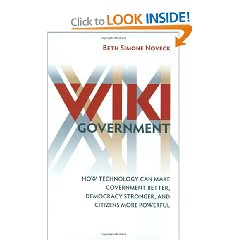
Review: Wiki Government–How Technology Can Make Government Better, Democracy Stronger, and Citizens More Powerful

4 Star, Best Practices in Management, Change & Innovation, Culture, Research, Democracy, Executive (Partisan Failure, Reform), Information Society, Information Technology, Intelligence (Public), Public Administration, Voices Lost (Indigenous, Gender, Poor, Marginalized)
Amazon Page

4.0 out of 5 stars Almost a Five–Making Wrong Things Righter

February 21, 2010

Beth Simone Noveck

I sat down intending to make this a five, but the two fluff reviews have to be off-set. Robert Ackoff would say this is a spectacular book about making the wrong things righter instead of the right things righter–too many lawyers and focused on improving a patent approval system that probably needs to be eradicated and the buildings and files plowed under with salt. It also lost one star because I was one of the 4,000 that actually participated in the Open Government experiment, where the legalization of marijuana triumphed and every time someone voted for my governance reform idea, a “monitor” from the partisan correctness office came in and voted against it moving it back down to zero. The author is naive to think this initiative is going anywhere without electoral reform that displaces the two-party tyranny and restores the Constitution, the Article 1 independence of an honest Congress, and integrity of the Executive at the political level. [See especially Chapter 21 in my new book that just went to the printer, INTELLIGENCE for EARTH: Clarity, Diversity, Integrity, & Sustainaabilty and is free online at Phi Beta Iota the Public Intelligence Blog, and my earlier wire-bound book, also free online, Election 2008: Lipstick on the Pig (Substance of Governance; Legitimate Grievances; Candidates on the Issues; Balanced Budget 101; Call to Arms: Fund We Not Them; Annotated Bibliography).

Having said that, I found this book to be spectacularly informative, thoughtful, useful, with extraordinary insights and suggestions that were over-shadowed by the focus on the patent system–suggestions about the-redesign of government, for example. I recommend reading my reviews of SMS Uprising: Mobile Activism in Africa and of The Myth of Digital Democracy along with this review, the three books were read together as a set. Below are some quotes and my fly-leaf notes. This book is a foundation stone for righteous change into the future, but only that first stone.

QUOTE (xvi): Done right, it is possible now to achieve greater competence by making good information available for better governance, improve effectiveness by leveraging the available tools to engender new forms of collective action, and strengthen and deepen democracy by creating government by the people, of the people, and *with* the people.

Continue reading “Review: Wiki Government–How Technology Can Make Government Better, Democracy Stronger, and Citizens More Powerful”