John Robb: Resilience 101 – Close the loop…all of them

Advanced Cyber/IO, Blog Wisdom, Communities of Practice, Earth Intelligence, Ethics, Key Players, Policies, Threats
0Shares
John Robb

RESILIENT PRODUCTION: Close The Loop!

Reslient, local production can reach amazing levels of capacity and efficiency by obsessively closing loops.  How do you close loops?  Simply:

  1. Turn the waste of one production process into the fuel/input required to operate another.
  2. Do that again and again and again until there is nothing left to reuse.
  3. All along the way, find ways to take the good parts out of each process.  It could be food in one.  Heating/cooling in another.  Fresh water in a third.

For example.  Let's say you want to produce vegitables and fish.  If you did it in a disconnected way, you would be hit with expenses (both monetary and time) at each step in the process.  You would need to fertilize the plants.  Feed the fish.  Clean the water.  It gets expensive early.

If you connected the production systems together, by closing the loops, you would have an aquaponics system.  In an aquaponics system, the fish waste feeds bacteria which in turn produces fertilizer for the plants and fresh water for the fish.  The food the plants produce generate excess that feeds the fish.  With a tiny bit of automation and design, the entire thing operates seemlessly.  Loop closed!  The biggest chore is collecting the bounty.

Closing loops can turn problems into opportunties.  Waste into bounty.

Paul Fernhout: Comments on Integrity at Scale

Advanced Cyber/IO, Analysis, Blog Wisdom, Budgets & Funding, Collective Intelligence, Communities of Practice, Counter-Oppression/Counter-Dictatorship Practices, Cultural Intelligence, Earth Intelligence, Ethics, Key Players, Policies, Serious Games, Threats
0Shares
Paul Fernhout

Just from the topics, it seems like a more coherent version of this stuff I wrote in 2004:  Achieving the Star Trek Society.

“This essay shows how a total of $14000 billion up front and at least another $2085 billion per year can be made available for creative investment in the USA by adopting a post-scarcity worldview. This money can help further fund a virtuous cycle of more creative and more cost saving efforts, as well as better education. It calls for the non-profit sector to help shape a new mythology of wealth and to take the lead in getting the average person as well as decision makers to make the shift in worldview to their own long term benefit. … Let us consider ways to free up money for the non-profit sector (or
reducing working hours) by cutting wasteful government and consumer
spending in these areas with (annual estimate of easy savings):

Continue reading “Paul Fernhout: Comments on Integrity at Scale”

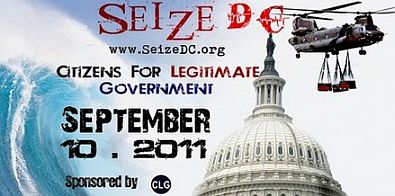
Event: 10 Sep Seize DC Citizens for Legitimate Government

Advanced Cyber/IO, Civil Society, Collective Intelligence, Cultural Intelligence, Ethics, Methods & Process
0Shares
Click on Image to Enlarge

SeizeDC.orgCitizens for Legitimate Government (CLG) calls for protest – SEIZE DC! SEIZE DC will begin on September 10, 2011, at noon, until finished. Why SEIZE DC? Endless, illegal, murderous and bankrupting war abroad; endless, brutal and bankrupting attacks on the vast majority at home–this is what we protest. How to SEIZE DC? We protest “peacefully,” although not passively. We do not accept marching orders. This is how we protest. [See Seize DC Endorsements.]

Reference: Integrity at Scale Free Online Book

5 Star, Best Practices in Management, Blog Wisdom, Change & Innovation, Complexity & Resilience, Culture, Research, Economics, Environment (Solutions), Information Society, Intelligence (Collective & Quantum), Intelligence (Public), Leadership, Monographs, Nature, Diet, Memetics, Design, Philosophy, Politics, Priorities, Public Administration, Truth & Reconciliation, Values, Ethics, Sustainable Evolution, Voices Lost (Indigenous, Gender, Poor, Marginalized)
0Shares
Click on Image to Enlarge


Recommended by Contributing Editor John Steiner

Source Home Page

Chapters with Links Below the Line

Continue reading “Reference: Integrity at Scale Free Online Book”

Review: A Democratic Approach to Sustainable Futures — A Workbook for Addressing the Global Problematique

5 Star, Complexity & Resilience, Consciousness & Social IQ, Culture, Research, Decision-Making & Decision-Support, Economics, Education (General), Education (Universities), Environment (Solutions), Future, Games, Models, & Simulations, Intelligence (Public), Nature, Diet, Memetics, Design, Peace, Poverty, & Middle Class, Politics, Priorities, Public Administration, Stabilization & Reconstruction, Strategy, True Cost & Toxicity, Truth & Reconciliation, Values, Ethics, Sustainable Evolution, Voices Lost (Indigenous, Gender, Poor, Marginalized)
0Shares
Amazon Page

Thomas R. Flannagan, Kenneth C. Bausch

5.0 out of 5 stars 2011 Workbook 49 Problems, 10 Clusters, & Software,July 22, 2011

This is a very reasonably priced workbook that can also be purchased in bulk (presumably at the standard 50% discount) from the publisher, and I certainly do recommend it as a toolkit for any level–undergraduate to postgraduate to professional–discussion about how to apply holistic analytics to complex problem sets.I rate it as a five for its intended purpose, but absent references to other critical supplements that I link to below, it is a four by which I mean it cannot comprise the sole text for teaching. As an endeavor in systemic thinking and a new tool for teaching systemic thinking, it is a six.Although I am generally hostile to software as a panacea that obscures more than it illuminates (especially if the assumptions buried in the code are flawed), I give the authors the benefit of the doubt, and would seek to integrate their endeavor with those of Medard Gabel, the State of the Future project, and other emerging efforts to create functional hybrid networked governance systems.Ambassador John McDonald provides the foreword, and I pull two quotes from him:QUOTE (vii): The theories are not particularly useful to develop predictive models.

QUOTE (viii): This is the book to prepare for the messy multi-layered, multi-faceted, personal, political real world of applied activism.

Continue reading “Review: A Democratic Approach to Sustainable Futures — A Workbook for Addressing the Global Problematique”

Koko: Hospitals Riskier than Flying…

07 Health, 07 Other Atrocities, 11 Society, Articles & Chapters, Commerce, Commercial Intelligence, Corruption, IO Impotency
0Shares
Koko the Reflexive

Hospital stays are riskier than flying, says WHO

CTV News.ca  Staff

Date: Friday Jul. 22, 2011 12

EXTRACT

According to Sir Liam Donaldson, the WHO's newly-appointed Envoy for Patient Safety, the chances of dying from a medical error in a hospital anywhere in the world is about 1 in 300. That compares with the risk of dying in a plane crash,  of about 1 in 10 million passengers.

Read full article…

Phi Beta Iota:  this story encapsulates much of what is wrong with modern society, from fog facts (knowns that are not known by most) to corruption.  When combined with the documentation on 50% of every health dollar being waste, and the larger challenge of incoherent uniniformed policy across all ten threats and all twelve core policy domains.

See Also:

Graphic: Information Pathologies

Graphic: Intelligence Maturity Scale