Venessa Miemis: Share or Die–Find Your Tribe and Do

03 Economy, 11 Society, Advanced Cyber/IO, Blog Wisdom, Civil Society, Collective Intelligence, Commerce, Ethics, Gift Intelligence
0Shares
Venessa Miemis

This post is a contribution i made to Shareable magazine’s new ebook – Share or Die. hope you enjoy my story.

Share or Die

It’s October 2010, and I’m reclined in an all expenses paid seat in business class on a flight to Berlin. I’m going there for two weeks to collaborate on a video project with a couple of artists I met online, then flying to Amsterdam to present the video to a room full of bankers at the largest financial services conference on the planet. I’m not a media producer, nor do I work in the financial industry. All I can think to myself is “How the hell did I get here?”

. . . . . . .
Now I see this life as an Epic Adventure, with each of us in control of being the hero of our own personal mission. Here are three big insights I’ve had these past few years that make me confident in this belief:

Your community already exists, and is waiting for you.

Your vision already exists – it is a shared one.

The tools of empowerment already exist, and are ready to be wielded.

The pieces you need really are there, they’re just often hard to recognize. I went through a long phase of utter despair and hopelessness, and had no idea how to move forward. Only after putting myself out there with authenticity and a beginner’s mind did I see I was surrounded by a community of change agents with the heart, the vision, and the capacity to act.

As we all move forward in building the kind of society we want to see and the lives we want to lead, we realize more and more that everything is interconnected and we can go further by connecting, collaborating, and amplifying each other’s efforts than by stubbornly trying to reinvent the wheel.

We’re all in this together. Find your tribe and go change the world.

Read full post….

Review (Guest): Cotton and Race in the Making of America

5 Star, Atrocities & Genocide, Capitalism (Good & Bad), Civil Society, Corruption, Crime (Corporate), Crime (Government), Culture, Research, Economics, Politics, Power (Pathologies & Utilization), Secession & Nullification, True Cost & Toxicity, Truth & Reconciliation, Voices Lost (Indigenous, Gender, Poor, Marginalized)
0Shares
Amazon Page

Gene Dattel

5.0 out of 5 stars Now I Better Understand What It Was All About,June 10, 2010

By  Richard P. Canon (Spartanburg, SC United States) – See all my reviews

Being a proud fifth-generation Southerner, I thought that I fully understood why the Civil War was fought. Most of my understanding was based upon the influence of society and culture within which I grew up. Although none of my family were flag flying Confederates, there was very much pride in being a Southerner and having ancestors who fought for the Confederacy.

After reading this book, I honestly believe that I better understand why the Southerners did what they did. Within my lifetime I have been told over and over that the war was fought over the issue of slavery. As this book shows, slavery was at the root of the war. The primary issue of the war, however, was pure economics.

Continue reading “Review (Guest): Cotton and Race in the Making of America”

John Steiner: The Human Cost of Economic Slavery

03 Economy, 07 Other Atrocities, 11 Society, Commercial Intelligence, Cultural Intelligence
0Shares
John Steiner

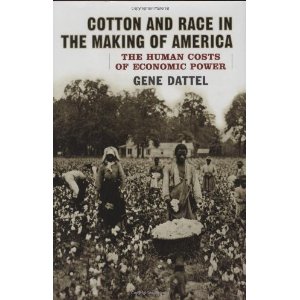
Just reading Cotton and Race in the Making of America, written by an old friend several years ago.  I think most would find it fascinating and worthy of review..  http://genedattel.com/

Amazon Page

“Gene Dattel has written a very important and necessary book, by locating the expansion of cotton production as a driving force not only in the antebellum South, but in the economy at large. He exposes slave-produced cotton's central role in causing the Civil War and as the global economic engine that prolonged slavery. Cotton was coveted by New York merchants and the textile barons of England and New England. He shows that after the Civil War cotton and race remained linked until technology finally displaced black labor. He devastatingly critiques the complicit role of the racist North in containing African Americans in the cotton fields. The legacy of this vital crop was economic growth and the social tragedy of slavery and segregation. No examination of American heritage is complete without an understanding of the force that cotton wrought upon its economic and social landscape. America's racial dilemma cannot be sequestered to one part of the country.” –Roger Wilkins, Clarence J. Robinson Professor Emeritus, George Mason University

Review: Critical Choices – The United Nations, Networks, and the Future of Global Goverance

5 Star, Best Practices in Management, Change & Innovation, Civil Society, Complexity & Resilience, Decision-Making & Decision-Support, Diplomacy, Economics, Environment (Solutions), Future, Information Operations, Information Society, Information Technology, Nature, Diet, Memetics, Design, Peace, Poverty, & Middle Class, Politics, Priorities, Public Administration, Security (Including Immigration), Stabilization & Reconstruction, Strategy, Survival & Sustainment
0Shares
Amazon Page

Wolfgang H. Reinicke (Editor), Francis Deng (Editor), Jan Martin Witte (Editor), Thorsten Benner (Editor), Beth Whitaker (Editor), John Gershman (Editor)

5.0 out of 5 stars Global Hybrid Network Governance Primer for UN+, July 21, 2011

By  Robert D. Steele (Oakton, VA United States) – See all my reviews

Last week I reviewed the first book on this topic by the first author (Wolfgang Reinicke), Global Public Policy: Governing Without Government. I overlooked that book published in 1998, and this book in 2000, for lack of consciousness. Evidently others did as well given the lack of reviews. What makes both these books even more important now is the appointment of the primary author, Wolfgang Reinicke, to the position of inaugural dean of the school of public policy at the Central European University founded and richly endowed by George Soros. To understand how much George Soros has broken away from the government-financial crime axis, his essay free online and also the first fifty-seven pages of The Philanthropy of George Soros: Building Open Societies is essential reading.

I read this book at three levels: for content on its merits; for insight into the specific individuals and agencies behind the book; and for insight into where George Soros might be hoping that Dean Reinicke will go with network governance, what some of us call Panarchy, which is rooted in what we call M4IS2 (Multinational, Multiagency, Multidisciplinary, Multidomain Information-Sharing and Sense-Making). In other words, secrecy is out, transparent true cost information about everything is in–transparency breeds truth, truth breeds trust, and this is how we achieve a non-zero prosperous world at peace that works for all, not just the top 1%.

On page 91 one finds a quote better suited to the front matter, from Kofi Annan:

QUOTE (91): The United Nations once dealt only with governments. By now we know that peace and prosperity cannot be achieved without partnerships involving governments, international organizations, the business community, and civil society.

Continue reading “Review: Critical Choices – The United Nations, Networks, and the Future of Global Goverance”

John Robb: US Legal Rot in Soviet-Style Collapse

09 Justice, Blog Wisdom, Commercial Intelligence, Corruption, Cultural Intelligence, Government, IO Impotency, Law Enforcement
0Shares
John Robb

JOURNAL: Legal Decay in a Soviet Style Collapse

Here's a question I got recently:  What happens to the legal system when the US suffers a Soviet style collapse?  Answer:  It will rapidly decay.

Here's a simple formula for this (it works for both legal systems and government bureaucracies):

Low legitimacy + slashed operating budgets = rampant corruption

Regardless of any decay in the legal system, business will still be conducted.  Small disputes will be resolved through the existing system, with graft tipping the scales or speeding the outcome.  Large disputes involving substantial wealth transfer will be something else entirely.  These disputes will be resolved through the ability of one party or the other to apply the threat of (or actual) violence to the negotiation process.

These pressures won't only be the result of counterparties that have access or control the large mafias/gangs/militias (or corporate militaries) that will spring up during economic collapse (far larger than we've seen the US to date).  Threats will also be mounted by government/defense/security officials that use their government sanctioned command of violence (police, SWAT, military units, etc.) as a means to personal enrichement.

This has pretty intersting implications for those GG readers that have large amounts of wealth in the current system.  You might not be able to retain it or move it or transact with it in a collapse scenario w/o putting your life (and those around you) at mortal risk.

NOTE:  We've already seen a taste of what's to come with the financial crisis of 2008.  In sum: it was the biggest financial crisis to date, full of fraud and deception across the board, and almost nobody was punished for it.  In fact, most were rewarded for their malfeasence with generous government bailouts and huge bonuses.