
Libya Internet Flatlines–Spurs Autonomous Internet

07 Other Atrocities, 08 Wild Cards, 10 Security, 11 Society, Autonomous Internet, Civil Society, Counter-Oppression/Counter-Dictatorship Practices, Government, Peace Intelligence, Technologies
0Shares

Libya Internet is down again, according to Google tool

March 4, 2011 | 10:22 am  Los Angeles Times

Libya-traffic

Libya has shut off the Internet again, according to a Google monitoring tool.

As of about 8 a.m. PST Thursday (or 6 p.m. in Tripoli, Libya's capital), the nation's Internet traffic began to flatline, and has been at zero since, says Google's Transparency Report.

Phi Beta Iota: While the world watches Libya, the USA is in the process of making the Internet a monopoly that can charge by the application instead of by the packet.  In brief, Internet “neutrality” is a  fraud in the USA, and the FCC is a front for the very large ISP's just as the Federal Reserve is a front for the private banks.  Autonomous Internet is something that matters everywhere, including especially the USA.

See Also:

Autonomous Internet (55)

Crisis Mapping Libya: This Is No Haiti…

05 Civil War, 07 Other Atrocities, 08 Wild Cards, Advanced Cyber/IO, Civil Society, Mobile, Peace Intelligence, Policies, Real Time
0Shares
Michael Ostrolenk Recommends...

Crisis Mapping Libya: This is No Haiti

Patrick Meier

March 4, 2011 at 8:14 am

We activated the Standby Volunteer Task Force (SBTF) on March 1st and quickly launched a Crisis Map of Libya to support humanitarian preparedness opera-tions. This is the largest deployment of the Task Force since it was formed at the 2010 International Conference on Crisis Mapping in Boston (ICCM 2010). I'm amazed at how far we've come since the response to the Haiti earthquake.

Phi Beta Iota: We've been championing Open Everything since 1988, each year growing from our first realization that Open Source Intelligence (OSINT) was urgently needed to bring government back to accountability, legitimacy, and sanity through transparency.  Below are two graphics, two briefings and two chapters that summarize our recent work in this area.  Here we want to emphazize the emergence of the Autonomous Internet Road Map and the fact that the Crisis Mapping initiative is a very strong manifestation of the power of public intelligence in the public interest.

See Also:

Graphic: Open Everything

Graphic: Intelligence Maturity Scale

2010 M4IS2 Briefing for South America — 2010 M4IS2 Presentacion por Sur America (ANEPE Chile)

2010 The Ultimate Hack Re-Inventing Intelligence to Re-Engineer Earth (Chapter for Counter-Terrorism Book Out of Denmark)

2007 Open Everything: We Won, Let’s Self-Govern

Seven Answers–Robert Steele in Rome

Field to Fork: Tracking produce back to farmers

01 Agriculture, Technologies, Tools, True Cost
0Shares

Harvestmark offers a mobile phone application and website that allows consumers to trace their food back to the farmers who grew it.  How much do we know about what is on our plate, and how easy is it to trace its source?

Source BBC

Phi Beta Iota: This is HUGE because it enables “true cost” information for each individual product to be posted on the web and instantly available to the smart phone user (the billion that buy most of the toxic products).  In many ways, this one capability marks the beginning of the integration of the Internet of people, the Internet of things, and the Internet of facts.

|
|
|
|
Related
:

True Cost Wiki

Sourcemap.org

Review: Long Strange Journey–An Intelligence Memoir

6 Star Top 10%, America (Founders, Current Situation), Atrocities & Genocide, Censorship & Denial of Access, Complexity & Catastrophe, Congress (Failure, Reform), Consciousness & Social IQ, Corruption, Country/Regional, Crime (Government), Culture, Research, Disease & Health, Empire, Sorrows, Hubris, Blowback, Executive (Partisan Failure, Reform), History, Impeachment & Treason, Intelligence (Government/Secret), Justice (Failure, Reform), Military & Pentagon Power, Misinformation & Propaganda, Politics, Power (Pathologies & Utilization), Priorities, Public Administration, Science & Politics of Science, Secrecy & Politics of Secrecy, Security (Including Immigration), Threats (Emerging & Perennial), True Cost & Toxicity, Voices Lost (Indigenous, Gender, Poor, Marginalized)
0Shares
Amazon Page

Patrick G. Eddington (Author)

5.0 out of 5 stars6+ Deep Moral Practical Look at Loss of Integrity Across US National Security

February 28, 2011

FINAL REVIEW

It is difficult for any intelligence book to make it to my 6+ category, or top ten percent. What brings this book to the very top of the heap is the skillful weaving of a constant appraisal of the moral in tandem with the practical. Sight unseen I knew this book would be a five, but it jumped to six when I read it from the back to the front and saw:

Page 354: The Agency has become inbred, ossified, parasitic…a prescription for the abuse of individual rights and fatally flawed analyses of the world-at-large that have plagued CIA over the past 30 years…

In the same concluding chapter he slams Congress for not demanding full access to classified information and the Congressional intelligence committees for serving as controllers of Congressional access rather than oversight bodies, with a particular disdain and disinterest in whistle-blowers; the Pentagon for infecting its own troops with alleged medicine that cause neurological problems, and for consistently covering up and lying to one and all about the causes of Gulf War syndrome; and the US Government generally for isolating “military medicine” from civilian medicine to the point that the troops are guinea pigs for bad science, and then victims of cover-ups that would not be countenanced outside the Pentagon.

Continue reading “Review: Long Strange Journey–An Intelligence Memoir”

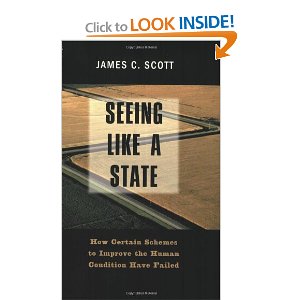
Review (Guest): Seeing Like a State–How Certain Schemes to Improve the Human Condition Have Failed

5 Star, Congress (Failure, Reform), Crime (Government), Culture, Research, Economics, Empire, Sorrows, Hubris, Blowback, Environment (Problems), Executive (Partisan Failure, Reform), History, Military & Pentagon Power, Nature, Diet, Memetics, Design, Peace, Poverty, & Middle Class, Philosophy, Politics, Power (Pathologies & Utilization), Priorities, Public Administration, Secrecy & Politics of Secrecy, Strategy, Survival & Sustainment, True Cost & Toxicity, Truth & Reconciliation, Values, Ethics, Sustainable Evolution, Voices Lost (Indigenous, Gender, Poor, Marginalized)
0Shares
Amazon Page

Professor James C. Scott (Author)

5.0 out of 5 stars Structural Dysfunctionalism

November 18, 2001

ByMichael Biggs (Oxford, United Kingdom) – See all my reviews

James Scott is known for portraying the moral world of peasants, showing how they have resisted the encroachment of capitalism and the state. Now he investigates the other side: the experts, bureaucrats, and revolutionaries whose grandiose schemes to improve the human condition have inflicted untold misery on the twentieth century. Seeing Like a State can be read, along with Foucault's Discipline and Punish and James Ferguson's The Anti-Politics Machine, as a classic of ‘structural dysfunctionalism.' The point (put metaphorically) is not merely that the cure for social ills has proven inadequate-but that the disease inhered in the diagnosis, and that failure will continue so long as the doctors prevail.

The dysfunction, Scott argues, derived from three modern conditions.

Continue reading “Review (Guest): Seeing Like a State–How Certain Schemes to Improve the Human Condition Have Failed”

Autonomous Internet: 4chan and anonymnity

Autonomous Internet, Civil Society, Cultural Intelligence
0Shares
Jon Lebkowsky Bio

4chan and anonymity

Marc Savlov interviewed me for this article in the Austin Chronicle, generally about anonymity on the Internet and specifically about 4chan. I hope I made the point that anonymity is a wicked problem (what is identity, anyway?), and that it’s sometimes a solution (as in police states, viva Tor).

Coincidentally I had interviewed the phenomenal Tom Jennings yesterday for Plutopia News Network, and when he saw the Chronicle article, he sent this link to to a paper he’d written about 4chan.

“The effect of the code mechanisms chosen by 4chan encloses a robust and stable culture of a form and shape not possible in more finely controlled environments, and that code is deceptively simple.”

Christopher Poole, aka Moot, creator of 4chan, will deliver a keynote at 2pm Sunday, March 13, at SXSW Interactive.