Review: International Peace Observations

5 Star, Civil Affairs, Complexity & Resilience, Country/Regional, Culture, Research, Force Structure (Military), Information Operations, Insurgency & Revolution, Intelligence (Public), Misinformation & Propaganda, Peace, Poverty, & Middle Class, Politics, Power (Pathologies & Utilization), Public Administration, Religion & Politics of Religion, Secrecy & Politics of Secrecy, Security (Including Immigration), Stabilization & Reconstruction, Survival & Sustainment, Threats (Emerging & Perennial), Truth & Reconciliation, United Nations & NGOs, Voices Lost (Indigenous, Gender, Poor, Marginalized), War & Face of Battle

Amazon Page

5.0 out of 5 stars Seminal Work Cited by Dr. Walter Dorn
July 23, 2010
David Wainhouse

EDIT of 6 Sep 2010 to add comments on books once received.

I bought this book, a real bargain, at the suggestion of Dr. Walter Dorn, the “dean” of the peace intelligence scholars, who cites the book with great favor in his own forthcoming book, KEEPING WATCH: Monitoring and Technology in UN Peace Operations, which I am going through now in galley form.

Now that I am holding it in my hands, here are some comments.

1)  Published in 1966, it is a phenomenal, an utterly superb, historical review of League of Nations, Latin American Union, and UN peace observation missions from 1920 to 1965.  The book concludes with a major section on “Strengthening Peace Observations.”

2)  Right away I decide to donate this book to the George Mason University library without marking it up, nor am I reading it, having seen enough to understand why Professor Dorn recommends it so highly as a historical reference work.

3)  The book clearly needs a sequel, from 1966 to date, over 40 years of new conflicts and new peace missions, and I make mention of this hoping that someone reading this review will be inspired to take on the project with many collaborators.

Other related books I have reviewed:
Peacekeeping Intelligence: Emerging Concepts for the Future
Intelligence and the War in Bosnia: 1992-1995 (Perspectives on Intelligence History)
U.S. Commercial Remote Sensing Satellite Industry: An Analysis of Risks
Peacekeeping and Public Information: Caught in the Crossfire (Cass Series on Peacekeeping, 5)
Public Information Campaigns in Peacekeeping : The UN Experience in Haiti

Continue reading “Review: International Peace Observations”

Review: Building Social Business–The New Kind of Capitalism that Serves Humanity’s Most Pressing Needs

6 Star Top 10%, Associations & Foundations, Best Practices in Management, Capitalism (Good & Bad), Change & Innovation, Civil Society, Complexity & Resilience, Consciousness & Social IQ, Culture, Research, Economics, Environment (Solutions), Humanitarian Assistance, Information Society, Intelligence (Collective & Quantum), Intelligence (Public), Intelligence (Wealth of Networks), Justice (Failure, Reform), Nature, Diet, Memetics, Design, Peace, Poverty, & Middle Class, Priorities, Public Administration, Technology (Bio-Mimicry, Clean), True Cost & Toxicity, Truth & Reconciliation, United Nations & NGOs, Values, Ethics, Sustainable Evolution, Voices Lost (Indigenous, Gender, Poor, Marginalized), Water, Energy, Oil, Scarcity
Amazon Page
5.0 out of 5 stars 4 in isolation, beyond 6 in context–a cornerstone book

July 14, 2010

Muhammad Yunus and Karl Weber

While I sympathize with those who feel that the book lacks reference to prior art, that social business has been around for a very long time, and that much of the book is somewhat similar to his first book that I also reviewed, Creating a World Without Poverty: Social Business and the Future of Capitalism, I am rating this book a five here and a “6 Star & Beyond” at Phi Beta Iota the Public Intelligence Blog, for the simple reason that he is not just doing it, but doing it on a global scale, pushing the envelope across all boundaries, and setting the stage for realizing what Nobel-candidate C. K. Prahalad articulates in The Fortune at the Bottom of the Pyramid, Revised and Updated 5th Anniversary Edition: Eradicating Poverty Through Profits.

The Nobel Prize to Yanus was a righteous one–unlike the political idiocy of awards to Al Gore and Barack Obama. I can only hope that the Norwegian public shames its overly political Nobel Committee into getting back on track with awards such as this one.

My friend Howard Bloom has a new book out that complements this one: The Genius of the Beast: A Radical Re-Vision of Capitalism and of course there are others both recent and past, such as Capitalism at the Crossroads: Next Generation Business Strategies for a Post-Crisis World (3rd Edition).

Three things are changing that make this book a cornerstone book:

Continue reading “Review: Building Social Business–The New Kind of Capitalism that Serves Humanity's Most Pressing Needs”

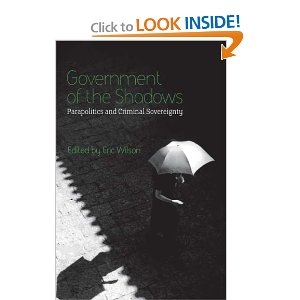
Review (Guest): Government of the Shadows–Parapolitics and Criminal Sovereignty (Paperback)

5 Star, Banks, Fed, Money, & Concentrated Wealth, Capitalism (Good & Bad), Empire, Sorrows, Hubris, Blowback, History, Impeachment & Treason, Intelligence (Government/Secret), Military & Pentagon Power, Misinformation & Propaganda, Peace, Poverty, & Middle Class, Politics, Power (Pathologies & Utilization), Security (Including Immigration), Strategy, Survival & Sustainment, Threats (Emerging & Perennial), True Cost & Toxicity, Truth & Reconciliation, United Nations & NGOs, Values, Ethics, Sustainable Evolution, Voices Lost (Indigenous, Gender, Poor, Marginalized)
Amazon Page

Review by Guido G. Preparata (Rome, Italy)

5.0 out of 5 stars Innovative and courageous social science

June 8, 2009

Eric Wilson and Tim Lindsey (eds)

In this recent volume by Pluto Press, Eric Wilson (Monash University) has assembled an all-stars team of politologists with the objective of changing the face of social analysis. This effort stems from the urgency to redefine the conceptual spaces within which we perforce corral our daily experience as citizens of what has become, in fact, an international polity of overwhelming, as well as highly disquieting, complexity. This is not at all to say, however, that the project limits itself to adding “epicycles,” as it were, to the Ptolemaic vulgate of British constitutionalism–i.e., the standard model of the “Liberal State”–which has imposed itself as the sole lens through which one is to contemplate the social dynamics for every single political reality of this world.

Government of the Shadows (GOS) represents in this regard an honest and brave swerve away from the mainstream in two fundamental respects.

First, it wishes to rethink political science entirely, by rejecting definitively the puritanical dichotomization of society into its predominant and “clean” edifice versus the latter's more or less corrupt “covert netherworld” (p. 228)–the prescriptive implication of conventional analysis being that delinquents need only be jailed, and their activities repressed, as the given regime is in the meantime steered (hopefully) toward the eventual and complete assimilation of Liberal institutions, which will naturally cure it of the criminal deviancy.

Second, and no less important, this project seeks to re-endow the movement for social justice of a unity of intent and of thought, which has lately been shattered by an excessive methodological preoccupation with multiplicity and diversity. By denouncing with reason and cogency the inequities suffered by a majority of innocents–throughout our recent history and all over the world–at the hands of identifiable, responsible parties within the power apparatuses in connivance with the world's mafias, and by ordering all such phenomenological mass into theory, this book, as a collective endeavor, acts as a vigorous reminder that realistic sociological analysis is also very much an instrument of pacific dissent. In this sense, GOS stands as a first and decisive installment of a modern anti-oligarchic theory.

To compass the reality of modern power games in its full spectrum, GOS innovates by proposing the new discipline of “parapolitics,” defined in Robert Cribb's introductory as “the study of criminal sovereignty, of criminals and sovereigns behaving as criminals in a systematic way” (p. 8).

Continue reading “Review (Guest): Government of the Shadows–Parapolitics and Criminal Sovereignty (Paperback)”

Review: Of Centuars and Doves–Guatemala’s Peace Process

5 Star, Best Practices in Management, Country/Regional, Insurgency & Revolution, Peace, Poverty, & Middle Class, Power (Pathologies & Utilization), Security (Including Immigration), Stabilization & Reconstruction, United Nations & NGOs
Amazon Page

5.0 out of 5 stars Absolutely a Core Work for the Region and the UN Role in Enabling Peace–Future Oriented as Well


April 3, 2010

Susanne Jonas

I am stunned not to find numerous reviews of this excellent work, a fleshing out of the author's highly-regarded (within the United Nations and global peace-process circles) “The Mined Road to Peace in Guatemala,” (North-South Agenda Paper #38, September 1999. As of today, 3 April 2010, her paper and her book are still the core references for those who seek to extend the model elsewhere in Central and Latin America.

See also:

The Battle For Guatemala: Rebels, Death Squads, And U.s. Power (Latin American Perspectives Series, No 5) – Spanish edition, with new introduction/update, La Batalla por Guatemala (Caracas, Venezuela: Nueva Sociedad and FLACSO/Guatemala, 1994);

La Ideología Social Demócrata en Costa Rica (San José, Costa Rica: Editorial Universitaria Centroamericana (EDUCA), 1984); and

Guatemala: Plan Piloto para el Continente (translation of Ph.D. dissertation) (San José,: EDUCA, 1981).

This author was at least a decade if not two decades ahead of her peers and the conventional idiocy in Washington, D.C.   Everything she has ever thought, particularly with respect to migrating the process of peace toward a process of prosperity, is relevant right this minute.

The quality of this work overcomes what would normally be a one-star deduction for a lazy unprofessional publisher failing to list the table of contents and provide a sample chapter or even better, assuring Inside the Book information including the Index, one of Amazon's best offerings.

Vote on Review

Review: A New World Order

5 Star, Change & Innovation, Complexity & Resilience, Decision-Making & Decision-Support, Democracy, Diplomacy, Information Operations, Information Society, Intelligence (Government/Secret), Intelligence (Public), Peace, Poverty, & Middle Class, Politics, Priorities, Security (Including Immigration), Survival & Sustainment, United Nations & NGOs, Values, Ethics, Sustainable Evolution
Amazon Page

5.0 out of 5 stars For a Serving Elite, Genius–Out of Touch with Non-Elites

February 20, 2010

Anne-Marie Slaughter

Now that my own book INTELLIGENCE for EARTH: Clarity, Diversity, Integrity, & Sustainability is at the printer am back into reading and really looking forward to catching up with the 25 books on my “to do” shelf. This one jumped to the top of the list at the recommendation of James Fallows, recently back from China and author of Blind Into Baghdad: America's War in Iraq among many other extraordinary books.

This might have been a four because despite the gifted genius of the author–I use the term with admiration–the book is out of touch with two thirds or more of the relevant literature and all the non-elite movements that are doing precisely what she advocates but DISPLACING governments.

HOWEVER, the recurring theme of multinational information-sharing and information-driven harmonization grabbed me by the throat. A handful of quoted phrases, generally citing others properly end-noted:

+ European agencies “are best described as ‘information agencies.' Their job is to collect, coordination, and disseminate information needed by policymakers.

+ “Modes of regulation based on information and persuasion…”

+ “Debousee also sees the European information agencies as network creators and coordinators.”

+ “In short, the ability to provide credible information and an accompanying reputation for credibility become sources of soft power.” She acknowledged here that non-governmental organization networks are doing this now, and that government networks need to do more of this.
Continue reading “Review: A New World Order”

Review: World Out of Balance–International Relations and the Challenge of American Primacy

4 Star, Country/Regional, Diplomacy, Economics, Empire, Sorrows, Hubris, Blowback, Military & Pentagon Power, Power (Pathologies & Utilization), Security (Including Immigration), United Nations & NGOs
Amazon Page

4.0 out of 5 stars Erudite, Itself Out of Balance, Secoond Tier Reading
January 8, 2010

Stephen Brooks and William Wohlforth

This is one of three books I bought to reflect on the same generic topic, the other two are Power & Responsibility: Building International Order in an Era of Transnational Threat and To Lead the World: American Strategy after the Bush Doctrine, which I will read and review this week-end.

It is a substantive contribution, important, but second tier in terms of clarity and utlity and comprehensiveness.

The authors do a fine job of setting the stage for why this book matters in relation to policy, putting forth three overarching questions worth quoting:

1. Can the United States sustain an expansive range of security commitments around the globe?

2. Is the United States well positioned to reshape the international system to better advance its security interests?

3. What are the general costs of unilateralism?

I have mixed feelings about this book for three reasons:

Continue reading “Review: World Out of Balance–International Relations and the Challenge of American Primacy”

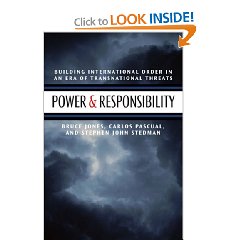
Review: Power & Responsibility–Building International Order in an Era of Transnational Threat

4 Star, Diplomacy, Disaster Relief, Environment (Problems), Humanitarian Assistance, Stabilization & Reconstruction, Terrorism & Jihad, Threats (Emerging & Perennial), United Nations & NGOs
Amazon Page

4.0 out of 5 stars Bubba Book

January 6, 2010

Bruce Jones, Carlos Pascual, Stephen John Stedman

EDIT of 7 Jan 09.  I got halfway through another book last night and now understand the Princeton-based idea that the US has enough power to demand changes and that earlier “balance of power” constraints might not apply.  On the one hand, this is an idea worth pursuing, but if you know nothing of strategy, intelligence (decision-support) and how to integrate Whole of Government and Multinational Engagement campaigns against the ten threats by harmonizing the twelve policies and engaging the eight demographic leaders, then this is just academic blabber.  On the other hand, this is 100% on the money–if the USA were a Smart Nation with an honest government, now is the time to lead–but it's not going to come out of the ivory tower or politicals in waiting for their next job, it will come from the bottom (Epoch B), the poor, and the eight demographic powers (Brazil, China, India, Indonesia, Iran, Russia, Venezuela, and Wild Cards such as South Africa, Thailan, and Turkey, with the Nordics and BENELUX always lurking positively on the fringes.

Original review:

I tried hard to find enough in this book to warrant five stars, but between the pedestrian threats, buying in blindly to the climate change fraud, assertions such as “There is no prospect for international stability and prosperity in the next twenty years that does not rest on U.S. power and leadership,” and the general obliviousness of the authors to multiple literatures highly relevant to their ostensible objective of answering the question “how do we organize our globalized world,” this has to stay a four. It has some worthwhile bits that I itemize below, but on balance this is an annoying book, part cursory overview, part grand-standing proposals for new organizations, and part job application–at least one of these authors wants to be the first High Commissioner for Counter-Terrorism.

Although the authors are familiar with A More Secure World: Our Shared Responsibility–Report of the Secretary-General's High-level Panel on Threats, Challenges and Change, which was published in 2004, this book does not resonate with the ten priorities set forth there, in this order:

01 Poverty
02 Infectious Disease
03 Environmental Degradation
04 Inter-State Conflict
05 Civil War
06 Genocide
07 Other Atrocities
08 Proliferation
09 Terrorism
10 Transnational Crime

Had the author's actually sought to tailor their suggestions to the above elegant threat architecture, this could have been a much more rewarding book. As it is, it strikes me as a book written around a few ideas:

Continue reading “Review: Power & Responsibility–Building International Order in an Era of Transnational Threat”

noble gold