
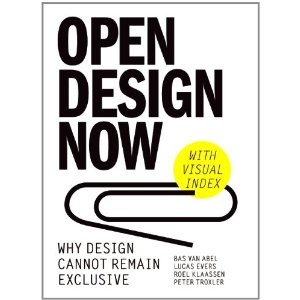
Two Books: Open Government: Collaboration, Transparency, & Participation (Tired), Open Design Now: Why Design Cannot Remain Exclusive (Wired)

Change & Innovation, Consciousness & Social IQ, Economics
Amazon Page

The most basic definition of open government is the idea that people have the right to access the documents and proceedings of government. Being able to closely examine decisions, policies, and procedures is foundational to having the ability to make intelligent and informed decisions as a citizen, especially in a democracy where an informed electorate is vital if good choices are to be made by voters when selecting leaders or holding them accountable.

The Open Government movement is not officially organized as a group or party, rather it is a growing collection of concerned citizens who want to help create better government by increasing citizens' access to information. It has been heavily influenced by the open source software movement and has similar aims: increased collaboration through making options available to any interested party willing to read and study, increased transparency by making source materials freely available for anyone to peruse and examine, and increased participation by eliminating closed systems wherever possible.

Open Government: Collaboration, Transparency, and Participation in Practice is a collection of 34 essays written by a wide variety of people who are interested in both promoting the philosophy of open government and in suggesting practical ways to implement procedures that will assist in applying that philosophy.
Amazon Page

How Much of the Economy is Friction?

Shared ownership vs. peer to peer rentals

#OccupyWallStreet and the issue of power: on not confusing Power-to and Power-over

The world-historical importance of #15M and #OccupyWallstreet: Using Lateral Power to Transform the Political/Economic Landscape

P2P Microfinance’s thousand points of light: Kiva’s Intercontinental Ballistic Visualization

Producing for our own consumption: generalizing the Scott Bader experience

Arthur Brock & Eric Harris-Braun explain the Metacurrency Project at #OccupyWallStreet

McKenzie Wark: #OccupyWallStreet as an Occupation, not a Movement

Review: What Comes After Money?

5 Star, America (Founders, Current Situation), Banks, Fed, Money, & Concentrated Wealth, Capitalism (Good & Bad), Civil Society, Complexity & Catastrophe, Congress (Failure, Reform), Consciousness & Social IQ, Corruption, Crime (Corporate), Crime (Government), Culture, Research, Economics, Executive (Partisan Failure, Reform), Intelligence (Wealth of Networks), Nature, Diet, Memetics, Design, Peace, Poverty, & Middle Class, Politics, Power (Pathologies & Utilization), Threats (Emerging & Perennial), True Cost & Toxicity, Values, Ethics, Sustainable Evolution, Voices Lost (Indigenous, Gender, Poor, Marginalized)
Amazon Page

Daniel Pinchbeck and Ken Jordan (eds.)

5.0 out of 5 stars Forward-Thinking, Relevant to #OWS, Brilliant Sparks, October 22, 2011

This book is one of at least four that I would suggest are essential reading for any citizen in the aftermath of #OccupyWallStreet (now shortened to #OWS). The other three are:

Extreme Democracy
The Innovator's Manifesto: Deliberate Disruption for Transformational Growth
Sacred Economics: Money, Gift, and Society in the Age of Transition

This book is a spin-off from Reality Sandwich, an online creative blog founded by one of the contributing editors of this book. Billed as evolving consciousness one bite by bite, it offers a melange of forward thinking. Since I am a book person by nature (a digital immigrant), I particularly appreciate “best of the best” rendered in a value-added book form.

Twenty-two contributors focus on transforming currency and community with consciousness being the implicit third leg of the stool.

Everything here was written well in advance of #OWS, but as with the other three books I recommended above, could easily be adopted by #OWS as its own.

Continue reading “Review: What Comes After Money?”

Review: Extreme Democracy

6 Star Top 10%, America (Founders, Current Situation), Best Practices in Management, Civil Society, Complexity & Resilience, Consciousness & Social IQ, Democracy, Intelligence (Public), Nature, Diet, Memetics, Design, Peace, Poverty, & Middle Class, Philosophy, Politics, Priorities, Public Administration, Values, Ethics, Sustainable Evolution, Voices Lost (Indigenous, Gender, Poor, Marginalized)
Amazon Page

Mitch Ratcliffe, Jon Lebkowsky

5.0 out of 5 stars SIX STAR #OWS Primer Wow Wow Wow,October 20, 2011

I bought this book in October 2010 because I was getting to know both Mitch Ratcliff and Jon Lebkowsky better, but at first pass through it did not really draw me in. Then OccupyWallStreet happened. I read the book on the flight from the US to Spain where I am talking about commercial intelligence and integrity in the messed up new world, and this time around, the book grabbed me.

Because #OWS has brought to life the ideas the co-editors and various contributing authors understood well before 2004 and articulated in 2004, now I can absorb this book as much more meaningful and inspirational. Anyone associated with OccupyWallStreet in any way from direct to indirect, should read this book. I am donating my copy to the George Mason University Library as I do all my new books (they took over my entire library when I joined the UN back in 2010).

Continue reading “Review: Extreme Democracy”

Review (Guest): The Conquest of Violence – The Gandhian Philosophy of Conflict

5 Star, Asymmetric, Cyber, Hacking, Odd War, Best Practices in Management, Civil Society, Complexity & Resilience, Consciousness & Social IQ, Democracy, Economics, Education (General), History, Insurgency & Revolution, Intelligence (Public), Nature, Diet, Memetics, Design, Peace, Poverty, & Middle Class, Politics, Public Administration, Religion & Politics of Religion, Strategy, Survival & Sustainment, Values, Ethics, Sustainable Evolution, Voices Lost (Indigenous, Gender, Poor, Marginalized)
Amazon Page

Joan Valerie Bondurant

5.0 out of 5 stars Every One on Earth Should Read This Book!,August 12, 2009

This could quite well be the best book ever written about Gandhi's philosophy of conflict: satyagraha. Bondruant's book is systematic and thorough. She lived in India for years and even got a chance to interview Nehru and many of Gandhi's other colleagues about the nonviolent action they were mutually involved with, which eventually brought about Indian Independence. This book was first written either in 1953 or 1958. But this edition was revised in 1988 and includes new, important commentary and afterthought by the author.

The book is everything the other reviewer said, and more. Because the author takes such a systematic approach, I can't imagine a better introduction to Gandhi's philosophy of conflict. But the truly unique and most vitally important aspect of this book, in my opinion, is due to the author's orientation. Her field is political science. She was a researcher who held a high position at the University of California at Berkeley. And she claims that Gandhi's philosophy made a contribution to political science that no system of political theory has ever adequately dealt with before. In that sense, she says, that Gandhi's greatest contribution to the world may have been overlooked. And this, I think, is what makes this book one of the most important books of the 20th century.
Continue reading “Review (Guest): The Conquest of Violence – The Gandhian Philosophy of Conflict”

Review (Guest): American Nations – A History of the Eleven Rival Regional Cultures of North America

4 Star, America (Founders, Current Situation), Civil Society, Consciousness & Social IQ, Culture, Research, Economics, Education (General), Geography & Mapping, History, Insurgency & Revolution, Nature, Diet, Memetics, Design, Peace, Poverty, & Middle Class, Politics, Secession & Nullification, Threats (Emerging & Perennial)
Amazon Page

Colin Woodard

Phi Beta Iota:  Elevated to four stars on recommendation of Chuck Spinney.  Synopsis of book in article for:  A Geography Lesson for the Tea Party

3.0 out of 5 stars How many sub-nations compose the USA?,October 10, 2011

Many people think of the United States as a nation with two regional or sub-national entities — the North and the South. The two sub-nations have identifiable differences in outlook. The South, a traditionally rural and agricultural region, has always been perceived to have a relatively conservative and individualistic outlook, oriented toward small government and states rights. The North, dominated by urbanized commercial centers, has always been relatively more aligned with big government agendas, a natural characteristic of densely populated areas where most people's livelihoods are derived from industry and commerce.

The geographical, political, and cultural divides between the North and South have been fairly well defined by the “Mason-Dixon Line” — approximately the line of the Ohio and Potomac Rivers . Indeed states like Kentucky and Maryland are called “Border States” as if they were on an international frontier. And of course a military frontier DID materialize between the North and South when the Southern sub-nation attempted to assert its sovereignty during the Civil War.

This great divide between the Northern and Southern sub-nations continues to this day. I've read commentaries from foreigners who explain the politics of the United States as consisting of a struggle for dominance between the Northern and Southern sub-nations. We Americans refer to this as the “Red State / Blue State” divide. So the idea of the USA consisting of two sub-nations is well established.

The question this book addresses is whether it makes sense to subdivide the United States into MORE THAN TWO subnational entities. Others have asked this question before. Joel Garreau wrote about it in 1981 in his book THE NINE NATIONS OF NORTH AMERICA. I read NINE NATIONS then and concluded that it was partially valid in an economic sense, i.e. relatively more Westerners earn their livelihoods from mining, relatively more people on the Great Plains earn their living from growing wheat and corn and livestock, and relatively more Northerners earn their living from Industry. So from that perspective there are arguably nine economic nations in North America. But Garreau did not convince me that there are more than two political sub-nations inside the USA.

Continue reading “Review (Guest): American Nations – A History of the Eleven Rival Regional Cultures of North America”

Review: The Innovator’s Manifesto – Deliberate Disruption for Transformational Growth

5 Star, Asymmetric, Cyber, Hacking, Odd War, Banks, Fed, Money, & Concentrated Wealth, Capitalism (Good & Bad), Complexity & Resilience, Consciousness & Social IQ, Culture, Research, Economics, Information Society, Intelligence (Collective & Quantum), Intelligence (Public), Intelligence (Wealth of Networks), Nature, Diet, Memetics, Design, Peace, Poverty, & Middle Class, Strategy, Values, Ethics, Sustainable Evolution
Amazon Page

Michael Raynor

5.0 out of 5 stars Helps Understand OccupyWallStreet–Solid 5 Misses Mark on True Cost Economics,October 13, 2011

I was given this book as a gift, and could not have–in a million years of planning–gotten a better book relevant to OccupyWallStreet (OWS) than this book. I read it this morning while my MGB was in the shop recovering from my trip to NYC OWS 6-7 October (shredded the generator). Halfway through my notes, advanced here, I observe that the book is a pleasure to read and a substantial advance on the earlier disruption explorations.

While I sympathize with those who do not “get” this book and downgrade it, I gave it a solid five and seriously considered a six star plus (only 10% of my reviews go there) but kept it at five because any book that considers Walmart disruptive (which it is) without observing the “true cost” to society, the environment, government, and small businesses, is completely missing the big picture.

This book does go beyond the earlier book that I have also reviewed, The Innovator's Dilemma: The Revolutionary Book That Will Change the Way You Do Business, and while Clayton M. Christensen has been churning books out with variations on the theme, I do see in this book very important, useful, immediately applicable insights and would recommend buying the first Christensen book and this book (to which he writes a Foreword).

I am less interested in the emphasis that the author places on Disruption Theory being able to build a bridge from the art of successfully guessing what innovations with succeed to the science of increasing by 5% or more which innovations will succeed, but that is, as the author points out, very significant when you consider that the percentage improvement is on hundreds of billions of dollars of investment.

QUOTE (5): Disruption's central claim is “that an innovation has the best chance of success when it has a very different performance profile and appeals to cusomters of relatively little interest to dominant incumbents, and the organizaton commercializing it enjoys substantial strategic and operational autonomy.”

Could that be a description of OWS and the 99% that have been screwed over by the two-party tyranny that has shaken down Wall Street and the military, intelligence, health, energy, and prison complexes for political contributions (bribes) while discounting the public treasury by 95% (the going rate for an earmark is 5%)?  The 99% are of no real interest to Wall Street or the two-party crime family that has hijacked democracy, and OWS is demonstrating substantial strategic and operational autonomy. What neither the left or right “get” right now about OWS is that it is a manifestation of a broad view that we need to dismantle both parties and end institutionalized politics while restoring the sovereign individual.

Continue reading “Review: The Innovator's Manifesto – Deliberate Disruption for Transformational Growth”

Review (Guest): Democracy Incorporated – Managed Democracy and the Specter of Inverted Totalitarianism

4 Star, America (Founders, Current Situation), Censorship & Denial of Access, Civil Society, Communications, Congress (Failure, Reform), Consciousness & Social IQ, Corruption, Crime (Corporate), Crime (Government), Culture, Research, Democracy, Economics, Education (General), Executive (Partisan Failure, Reform), Impeachment & Treason, Information Operations, Justice (Failure, Reform), Media, Military & Pentagon Power, Misinformation & Propaganda, Nature, Diet, Memetics, Design, Peace, Poverty, & Middle Class, Politics, Power (Pathologies & Utilization), Secrecy & Politics of Secrecy, Threats (Emerging & Perennial), True Cost & Toxicity, Voices Lost (Indigenous, Gender, Poor, Marginalized)
Amazon Page

Sheldon S. Wolin

Editorial Review:

Of the many books I've read or skimmed in the past seven years that attempted to get inside the social and political debacles of the present, none has had the chilling clarity and historical discernment of Sheldon S. Wolin's Democracy Incorporated. Building on his fifty years as a political theorist and proponent of radical democracy, Wolin here extends his concern with the extinguishing of the political and its replacement by fraudulent simulations of democratic process. — Jonathan Crary, Artforum

4.0 out of 5 stars Managed Democracy, Superpower, and alas, even, “Inverted Totalitarianism”, June 17, 2008

ByJohn P. Jones III (Albuquerque, NM, USA) – See all my reviews  (VINE VOICE)    (TOP 500 REVIEWER)    (REAL NAME)

This is a seminal work which “tells it like it is” concerning the current power arrangements in the American political system, as well as the political leadership's aspirations towards global empire. Prof. Wolin sets the tone of his work on page 1, with the juxtaposition of the imagery of Adolph Hitler landing in a small plane at the 1934 rally at Nuremberg, as shown in Leni Reifenstahl's “Triumph of the Will,” and George Bush landing on the aircraft carrier “Abraham Lincoln” in 2003. Certainly one of the dominant themes of the book is comparing the operating power structure in the United States with various totalitarian regimes of the past: Stalinist Russia, Nazi Germany and Fascist Italy. Prof Wolin emphasizes the differences between these totalitarian powers, and the softer concentration of power in the United States, which he dubs “inverted totalitarianism.”

Continue reading “Review (Guest): Democracy Incorporated – Managed Democracy and the Specter of Inverted Totalitarianism”

noble gold