It would be great if progressive change could be achieved solely by pressuring Republicans, but that’s not how it works. It’s not just Wisconsin Governor Scott Walker, Congressmember Michelle Bachmann, and the Tea Party that hold back change – it’s the many Democrats who betray campaign promises to reward wealthy donors/corporate interests and/ or to “broaden” their base.
By David Greenberg, Washington Post Outlook, 29 July 2011
David Greenberg is a professor of history and of journalism and media studies at Rutgers University. He is a fellow at the Woodrow Wilson International Center for Scholars for the 2010-11 academic year.
EXTRACTS
“Age of Greed” chronicles how Americans ended up with the highly unregulated financial system that produced the meltdown of 2008 and the fallout that lingers three years later. What’s most novel about the book, which relies heavily on other secondary accounts, is that unlike other recent treatments of the financial crisis, it traces the origins of the problem not to the Bush or Clinton or even Reagan years, but all the way to the late 1960s.
. . . . . .
The real scandal revealed by Madrick’s important book is not the well-known tales of dastards such as telecom analyst Jack Grubman or Internet stock promoter Frank Quattrone, but the more elusive — and more consequential — story of how the government came to abdicate this supreme responsibility.
I have worked for several months to develop the ideas in this article and to articulate them in an accessible way. They are fundamental understandings underlying the co-intelligence vision of a wiser democracy.
If the ideas intrigue you, you can find a longer version with more detailed guidelines and references online. I wrote the abstract below to make it easier for you to see the whole pattern at once. I hope you find both versions interesting and useful.
As a civilization we have tremendous collective power, but we don't always use it wisely. We can make good decisions, but we face messy, entangled, rapidly growing problems with complex, debatable causes. Efforts to solve one problem often generate new ones. We need more than problem-solving smarts here. We need wisdom.
A good definition for wisdom here is
the capacity to take into account
what needs to be taken into account
to produce long term, inclusive benefits.
To the extent we fail to take something important into account, it will come back to haunt us. But often we only realize we overlooked something long after our decision has been implemented. Certain practices – because they lead us to include more of what's important – can help us meet this challenge. Here are eight complementary ways to do this. The more of them we do, and the better we do them, the wiser our collective decisions will be. Continue reading “Tom Atlee: Making Wise Decisions on Public Issues”
Attached 17-page (12 plus footnotes) paper is worth reading. Much to agree with, little to dispute. Major thesis is that Army has, since about 1989, transformed from a citizen force that may go nowhere for decades to a professional legion that deploys operationally on a routine basis.
The single part that most seized me is that portion of the abstract that reads, “… In the midst of a civilian society that is increasingly pacifistic, easygoing, and well adjusted, the Army (career and non-career soldiers alike) remains flinty, harshly results-oriented, and emotionally extreme. The inevitable civil-military gap has become a chasm.”
General Comment: as presented to non-governmental groups including Amazon, Gnomedex Bloggers, Hackers on Planet Earth, etcetera, the Open Source Agency (OSA) would be the proponent for everything open beginning with the four central opens necessary for Open Government: Open Source Software, Open Spectrum, Open Data Access, and Open Source Intelligence. Within the Department of State, an Office for Information-Sharing Treaties and Agreements would be central to the endeavor, and could reasonably also do outreach to all eight tribes across the USA (academic, civil society, commerce, government at all levels, law enforcement, media, military, and non-governments/non-profit).
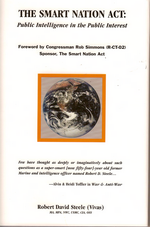
This book remains the single definitive reference on the Smart Nation Act as developed by Robert Steele in support of Congressman Rob Simmons (R-CT-02). As pointed out in Hamilton Bean's recently published book, No More Secrets: Open Source Information and the Reshaping of US Intelligence the Open Source Agency (OSA) has become the subject of competing visions–on one side, those who favor accountability, effectiveness, transparency, and respect for the public…..on the other, those who favor corruption, profitable waste, secrecy, and the exclusion of the public.
Most recently, INTELLIGENCE for EARTH: Clarity, Diversity, Integrity, & Sustainability provides the strategic, operational, tactical, and technical contexts for leveraging both Open Source Intelligence (OSINT) and Multinational, Multiagency, Multidisciplinary, Multidomain Information-Sharing and Sense-Making (M4IS2) in order to create a prosperous world at peace–and at one third the cost of what the USA spends on war today.
If an OSA is created–it can only be a success under diplomatic auspices as OMB has twice agreed (provided the Secretary of State asks for it as a sister agency to the Broadcasting Board of Governors (BBG), it could–it should–host the Multinational Decision Support Centre (MDSC) as proposed to DoD and implicitly called for in several Defense Science Board (DSB) reports. The MDSC could be located in Tampa, Florida, as the Coalition Coordination Centre has been, but staffed by intelligence professionals instead of logistics professionals.
Put most simply, an OSA restores intelligence and integrity to the entirety of the US Government, and changes everything about how we do policy, acquisitions, and operations. It restores the Republic.





 Brilliant Detailed Exposure of Power Killing Intelligence, July 30, 2011