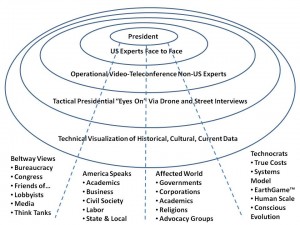
Forthcoming in Strategic Studies Institute Mongraph on Human Intelligence (HUMINT) approved for publication by CIA and DoD. In the interim, can be seen at www.oss.net/HUMINT.

The truth at any cost lowers all other costs — curated by former US spy Robert David Steele.
Forthcoming in Strategic Studies Institute Mongraph on Human Intelligence (HUMINT) approved for publication by CIA and DoD. In the interim, can be seen at www.oss.net/HUMINT.
Open design is the development of physical products, machines and systems through use of publicly shared design information. The process is generally facilitated by the Internet and often performed without monetary compensation. The goals and philosophy are identical to open source, but reside in a different paradigm.
Phi Beta Iota: The emergent Open Design community is a bit too focused on products, i.e. open source hardware. Open Design can and should apply to all processes, all services, all products. Unlike the assembly line focus on the Industrial Era, Open Design would integrate 360 degree cultural values (e.g. organic food to slow food to food-based dialog) and fully integrate the humanities with the mechanics to achieve Consilience.
Citizen science is a term used for projects or ongoing program of scientific work in which individual volunteers or networks of volunteers, many of whom may have no specific scientific training, perform or manage research-related tasks such as observation, measurement or computation.
The use of citizen-science networks often allows scientists to accomplish research objectives more feasibly than would otherwise be possible. In addition, these projects aim to promote public engagement with the research, as well as with science in general. Some programs provide materials specifically for use by primary or secondary school students. As such, citizen science is one approach to informal science education.
Phi Beta Iota: Citizen Science is in its infancy, but with the emergence of open source software and open source intelligence combinations such as represented by SourceMap.org, Citizen Intelligence and Citizen Counterintelligence are sure to be coming along soon….and if combined with multi-lingual networks such as provided by Telelanguage, a global multinational citizen information-sharing and sense-making grid can be created that implements the Swedish vision of M4IS2: Multinational, Multiagency, Multidisciplinary, Multidomain Information-Sharing and Sense-Making. This has enormous implications for both real-time science and real-time warning as well as real-time Emergency Action.

Leo is a doctoral candidate at the MIT Media Lab, a designer and an artist. He teaches the MIT class Future Craft: Radical Sustainability in Product Design on the social aspects of mass design. You can also find his blog, photos, and videos. To find out more and for contact information, download his resume.
PhD Thesis Proposal: “A Collective Approach to Sustainable Design”
SourceMap.org visible supply chains
Phi Beta Iota: We are deeply inpressed by this individual, who crosses harnesses Collective Intelligence to achieve Commercial Value in both Cultural and Earth contexts. His idea is infinitely scalable, infinitely valuable, and applicable to every single product and service on the planet, ultimately to included planned giving at the item level.

 An Utterly Superb Intellectual Contribution–a Major New Reference
January 10, 2010
David Cortright
This book is a gift to humanity, a foundational reference of such extraorindary value that I earnestly believe it should be required reading for every single liberal arts program in the world, and used as a core book in all graduate international relations programs.
Part I reviews the history of peace movements; Part II reviews core themes of peace within religions, populism, democracy, social justice, responsibility to protect and wraps up with three cahpters on a moral equivalent, realizing disarmament, and realistic pacifism.
The footnotes, the bibliography, and the index are world-class. The paper is glossy and annoyingly unreceptive to ink, but as a library volume or one that does not allow notes, this is an absolute top-notch production at a phenomenally reasonable price. I have the note mid-way: utterly brilliant blending of works of others within own architecture–superior scholarship.
The book does not touch on the evolutionary activism, conscious evolution, integral consciousness literature, and this is not a criticsm as much as a roadsign: the following five books complement this work in a distinct fashion.
Reflections on Evolutionary Activism: Essays, poems and prayers from an emerging field of sacred social change
Conscious Evolution: Awakening Our Social Potential
Integral Consciousness and the Future of Evolution
The Compassionate Instinct: The Science of Human Goodness
HUGE EYE-OPENER; Pashtun Peace Army in Pakistan-Afghanistan, the Servants of God, discussed on pages 193 and 313. I've been working Information Operations (IO) and used to do Covert Action and I am pretty sure neither CIA nor DIA have a clue that this is a major historical movement that could be reactivated.
Continue reading “Review: Peace–A History of Movements and Ideas”
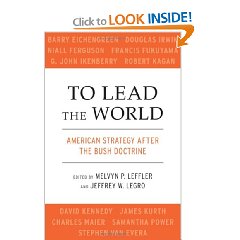 Superb From Right of Center–VERY Satisfying Competent Collection
Melvyn Leffler and Jeffrey Legro
Of the three books I bought to explore this particular theme, this was the best by far and the only one to earn five stars. Twelve chapters, twelve authors, not a single runt in this litter. The notes are outstanding.
Although this book's contributors are out of touch with the results of the UN High-Level Panel on Threats, Challenges, and Change, whose report, A More Secure World: Our Shared Responsibility–Report of the Secretary-General's High-level Panel on Threats, Challenges and Change (also free online) is now the global standard for any serious strategist and every globally-oriented intelligence professional, what this group knows and share is valuable and I found this book totally absorbing over two nights of reading. They do not, however, have a grip on intelligence or how deeply we have hurt–and have been perceived to have hurt–the rest of the world.
Early on as I go through the book fast I am impressed by the balance between skepticism of the traditional thinking and spending habits (one size fits all heavy metal military) and a focus on the importance of having a broad capability that can respond to and impact on a diversity of threats most of which cannot be easily anticipated.
Some highlights, generally identifying the specific author
Continue reading “Review: To Lead the World–American Strategy after the Bush Doctrine”
Wall Street Journal Reuel Marc Gerecht January 8, 2010 [safety copy of entire piece below the fold]
Amid the Hysteria, A Look at What al-Qaeda Can't Do
TIME Magazine By Peter Beinart Monday, Jan. 18, 2010
National Journal By James Kitfield Saturday, Jan. 9, 2010 [Subscription]
Hidden behind walls of top-secret classification, senior U.S. government officials meet in what is essentially a star chamber to decide which enemies of the state to target for assassination. There is no single master list, but all names pass through an elaborate, multi-agency vetting process that ends at the level of the National Security Council and ultimately requires presidential approval.
Overwhelm. Divide. Spread. Bankrupt. Diversify: Al Qaeda's new grand strategy
Washington Post By Bruce Hoffman January 10, 2010
London Sunday Times By David Leppard and Hala Jaber January 10, 2010
Continue reading “Journal: What Al Qaeda Et Al Can and Cannot Do”

![[gerecht]](http://s.wsj.net/public/resources/images/ED-AK786_gerech_D_20100107190103.jpg)