Nearly all of the 10,893 spent fuel assemblies at the Fukushima Daiichi plant sit in pools vulnerable to future earthquakes, with roughly 85 times more long-lived radioactivity than released at Chernobyl.
Invitation to the gathering of the commons, 30th June, 1-5 pm
Something new is moving, coming alive in London and it’s powerful. Similar to any big change in nature, it started in a way noticeable only to relatively few but have no doubt, it will grow fast and wide.
In November, Americans will have a chance to speak their minds.
And there's one thing everyone should agree on:
America just isn't working right now.
It's not just Americans who aren't working. It's America itself, a country whose economy once worked for almost everyone, not just the rich.
In the old America, if you worked hard, you had a good chance of moving up.
In the old America, the fruits of people's labors accrued to the whole country, not just the top.
In the old America, there was a strong middle class, and their immense collective purchasing power drove the economy for decades.
Click on Image to Enlarge
No longer.
Over the past couple of decades, the disparity between “the 1%” and everyone else has hit a level not seen since the 1920s. And there is a widespread and growing sense that life here is not fair or right.
If America cannot figure out a way to fix these problems, the country will likely become increasingly polarized and de-stabilized. And if that happens, the recent “Occupy” protests will likely be only the beginning.
The problem in a nutshell is this:
In the never-ending tug-of-war between “labor” and “capital,” there has rarely—if ever—been a time when “capital” was so clearly winning.
In fact, income inequality has gotten so extreme here that the US now ranks 93rd in the world in “income equality.” China's ahead of us. So is India. So is Iran.
Phi Beta Iota: The actual unemployment rate in the USA is 22.4%. Anyone that does not know this is part of the problem. Anyone that knows this and conceals it from the public is part of the corruption that has created the problem.
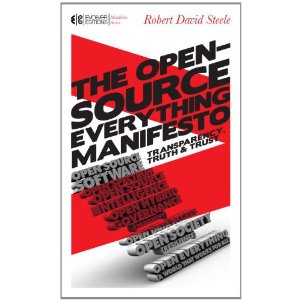
Read this compact book in an evening–and think about it for a year. Robert Steele long as been one of our most interesting and challenging thinkers (although his writing is clear–a reflection of clear thought), and this book is a cri de couer, his “Give me liberty, or give me death!” demand that our government, our system and our citizenry rethink the far from benevolent disorder into which we have lured ourselves.
My review cannot do justice to the richness of thought compressed in this book. Nor do I agree with every proposition the author raises–that's not the point, which is to spur us to liberated, creative thought. But I very strongly recommend this book to every citizen, no matter his or her political hue, who is unafraid of facing the future and who dares to embrace change.
5.0 out of 5 stars 6 Star (My Top 10%) Primer for Every Citizen,June 6, 2012
I've had this book in my stack of “to be read” books for some time now, and now that I have read it, I deeply regret not getting to it sooner. Although I have read and reviewed a number of vital serious books in this field, and list ten of them below, I have to say this is easily the single best book of the lot, and I put it into 6 stars and beyond — out of the 1,800 plus books I have reviewed at Amazon, fewer than 10% get this rating.
Perhaps because I had already read the ten books below, I was absolutely floored by the clarity, organization, precision, simplicity, intelligence, and general integrity of this book and its author. Please do take advantage of the Look Inside the Book feature that Amazon offers (click on book cover above). In seventeen chapters, the author has brought to the public a work of elegant explosive yet balanced and measured, FACTS with CONTEXT.
If you read only one book on the destruction of the US economy, the destruction of the US Republic, the destruction of legitimate governance in the USA, this is the one book I recommend. It should not only be read, but also shared. As I go back over the table of contents thinking about what to highlight (I no longer mark up books now that I donate them all as I finish reading them), I am just blown away by the medticulous, sensible, systematic, intuitively coherent manner in which the author starts with the fraud and treason of the Federal Reserve (neither Federal nor a reserve), and ends with his prescription for public banking that I heartily respect.
Now that stocks are back to reflecting nothing more than expectations of how many times the Chairsatan dilutes the existing monetary base in a carbon copy replica of not only 2011 but also 2010… and 2009 (because contrary to what purists may believe, the only way to inflate away unsustainable debt in a growth-free economy is by destroying the currency), and manic pattern chasers have crawled out of their holes proclaiming the death of the bear market after a two day bounce, what is happening in the actual economy, no longer reflected by the market, has once again been pulled back to the backburner.
Fastest Growing Job in USA
Which is sad, because while ever fewer people reap the benefits of artificial, centrally-planned S&P rallies, the rest of the population suffers, and what is worse: hope for a quiet, middle-class life is now an endangered species. Nowhere is this more evident than in the following list from David Rosenberg which summarizes how, quietly, the US labor force slipped back into a full-blown depression.
From David Rosenberg:
One Sick Labor Market
There were so many disturbing elements to the May jobs data that we're not sure we can do justice to the litany of disappointments (with some help from our friends at the Investor's Business Daily):
The share of long-term unemployment is at its highest level since the Great Depression (42%).
Fully 54% of college degree graduates under the age of 25 are either unemployed or underemployed.
45 million Americans are on food stamps — one in seven residents.
47% of Americans are on some form of government assistance.
The employment-to-population ratio for 25-54 year olds is now 75.7%, lower than it was when the recession supposedly ended in June 2009.
The number of people not in the labour force has swelled eight million since the recession ended; absent that effect, the unemployment rate would be 12% right now (about the same as President Obama's election chances would be).
The number of people confident enough to leave their jobs fell 11% in May
for the second month in a row to 891k, the lowest since November 2010.
The ranks of the unemployed who have been looking fruitlessly for work for at least 27 weeks jumped 310k in May, the sharpest increase since May 2011.
The unemployment rate for males aged 16-19 is 27% and for males between 20 and 24 it is 13%. Draw your own conclusions from a social (in)stability standpoint.
One in seven Americans are either unemployed or underemployed.
Only one in six of the youth are working full-time and three-in-five are living with their folks or another relative (as per the NYT).
A mere 16% of the 2009-2011 graduating class has found full-time work, while 22% are working part-time. Even those hired from 2006-08, just 23% are working full-time.
According to a poll cited in the NYT, just 14% of high-school grads today believe they will have a more successful financial future than their parents Line of the day, as depressing as it is, comes from an 18-year old: “Thank God I had a buddy at Burger King who could help me out”. Fast-food has emerged as the fast-growing industry in a country once led by technology. Even tech now is fuelled more by companies that produce nifty consumer gadgets and feed our narcissistic needs than those who focus on improving the nation's capital stock which is the ultimate trailblazer for productivity growth and durable gains in our standard-of-living.
Dr. Rolf Weber and R. Shawn Gunnarson have written a paper on ICANN accountability that has been accepted for publication by the Columbia Science and Technology Law Review. In brief, the paper argues that ICANN should hold the ICANN Board of Directors accountable through mechanisms both independent of the Board and binding on it. They further argue that such mechanisms should be grounded in traditional principles of constitutional government, such as the enumeration and separation of the Board’s powers, a declaration of stakeholder rights, and an independent tribunal with the authority to issue decisions binding on the ICANN Board. Such measures should be adopted through a ratification process that includes representatives from every sector of ICANN’s global stakeholder community.