Since Look Inside the Book is not provided for this extraordinary work, I will list the 9 chapter here (each with over ten sub-titles not listed here):
If there's a single Founding Father of the Open Source movement, Robert D. Steele is it. Everyone else has been playing catchup. And if you don't know what the Open Source revolution is, you need to read this book. You don't even need to know why! You need to buy it, read it, and then you'll *know* why. No other book on Open Source can open your eyes the way this one can. That's because there's no potential use of Open Source intelligence that Steele hasn't anticipated. Collective Intelligence is coming! It's an unstoppable force. And it will change everything. So if you like to know about things like that in advance, you need to buy this book.
The information age that was created by personal computers was just a kiddie car with a squeaky horn. By comparison, the open source revolution is a freight train. Its potential to change your world is orders of magnitude greater. This is not hyperbole. In fact superlatives can't begin to express the ground-shaking potential of this next wave of human evolution.
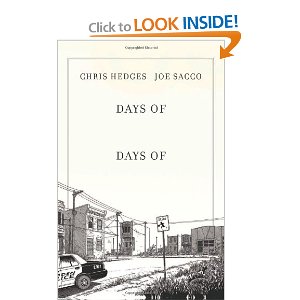
Chris Hedge's and Joe Sacco's new book, Days of Destruction, Days of Revolt, is a treasure. Hedges wrote the plain text. Sacco produced the text-heavy cartoon sections and other illustrations, which even I — not a big fan of cartoon books — found to enrich this book enormously.
Hedges and Sacco visit Pine Ridge, South Dakota, to examine the misery of the Native Americans who remain there. It's nice to think that we've corrected our crimes through political correctness, and yet they continue uninterrupted — unconscionably, intolerably, tragically. Here the human stories are told, and told by those affected and by those resisting and struggling to set things right. Ironically, the victims of the United States' first imperial slaughters are now disproportionately suffering the pain common to veterans of recent U.S. wars. That same pattern of widespread military experience is found in each of three other sections of the book as well, while other communities in this country have virtually no participation in the military.
Hedges and Sacco go to Camden, New Jersey, to examine the world of impoverished and ghettoized African Americans, whose lives have worsened by many measures over the past generation, despite the successes of the civil rights movement. Poor whites and others figure into the story as well, with special attention to those struggling to improve the world, whether on a small or large scale. Michael Doyle's voice is one of those from Camden residents that tell the story of decline and devastation that city has experienced:
5.0 out of 5 stars 6 Star (My Top 10%) Primer for Every Citizen,June 6, 2012
I've had this book in my stack of “to be read” books for some time now, and now that I have read it, I deeply regret not getting to it sooner. Although I have read and reviewed a number of vital serious books in this field, and list ten of them below, I have to say this is easily the single best book of the lot, and I put it into 6 stars and beyond — out of the 1,800 plus books I have reviewed at Amazon, fewer than 10% get this rating.
Perhaps because I had already read the ten books below, I was absolutely floored by the clarity, organization, precision, simplicity, intelligence, and general integrity of this book and its author. Please do take advantage of the Look Inside the Book feature that Amazon offers (click on book cover above). In seventeen chapters, the author has brought to the public a work of elegant explosive yet balanced and measured, FACTS with CONTEXT.
If you read only one book on the destruction of the US economy, the destruction of the US Republic, the destruction of legitimate governance in the USA, this is the one book I recommend. It should not only be read, but also shared. As I go back over the table of contents thinking about what to highlight (I no longer mark up books now that I donate them all as I finish reading them), I am just blown away by the medticulous, sensible, systematic, intuitively coherent manner in which the author starts with the fraud and treason of the Federal Reserve (neither Federal nor a reserve), and ends with his prescription for public banking that I heartily respect.
5.0 out of 5 stars End Result of Quarter Century Walk-About,June 5, 2012
Updated 27 June: Why on earth is this book in top 100 for Espionage? I can only speculate that because I am a former spy, trained over 7,500 intelligence professionals, and have been an arch critic of secret intelligence ever since my 1988 conversion experience, that those who know me or know of my work have tane an interest in the book. They are correct to do so. As the image I have loaded above with the cover, entitled “Intelligence Maturity,” clearly depicts, the craft of intelligence must evolve away from an obsession with spies and secrets and move rapidly through open sources and methods to M4IS2 (Multinational Multiagency Multidisciplinary Multidomain Information-Sharing and Sense-Making). Smart Nations and public intelligence in the public interest are the center of gravity for creating a world that works for all, not spies and secrecy that work more often than not for the 1% instead of the 99%.
Now that Look Inside the Book is up, I have deleted the table of contents and the list of opens I provided early on, and thank all those who went ahead with buying the book (Amazon has the lowest price I know of)—you helped put the book in Top 100 for Democracy most days since the book came out — Top 50 on 17 June. Although fleeting, these rankings are a small sign that the Open Source Everything meme has arrived.
The book evolved from my January 2007 keytone to Chris Prillo's Gnomedex in Seattle, the 64 minute video (and various shorter remixes including one that has gone around Anonymous circles) easily found by searching for < YouTube Steele Gnomedex 2007 > without the brackets. Contact Random House Special Markets to buy the book by the case at whatever discount is the norm for them. I am very eager to receive invitations to talk about this topic, especially in relation to the November 2007 “election” that pits one wing of the two-party tyranny against the other wing, with no difference for We the People.
I have to credit Tom Atlee, Jim Rough, Harrison Owen, Buckminster Fuller, Russell Ackoff, David Weinberger, Lawrence Lessig, Kent Myers, among many others, for the raw material that helped me flip the tortilla–this book is a rejection of tyranny, toxicity, and theft in favor of transparency, truth, and trust. I list a few books below, but point to all 1800+ of my non-fiction rewviews as relevant to the evolution of my thinking since I recognized the pathology of secret intelligence and rule by secrecy.
At Phi Beta Iota the Public Intelligence Blog I have and will continue to post three short excerpts from each chapter (up to Chapter 5 as of this update), and also posted the 33 graphics as color slides, and an interview by Warren Pollock of myself, 11 minutes long. He is a gifted interviewer and video editor, extracted with precision and presented with flair.
This book completes the circle I started walking in 1988.
Robert Steele
ON INTELLIGENCE: Spies and Secrecy in an Open World
5.0 out of 5 stars Intelligent, Endearing, Inspiring, Useful, Rooted in Reality, June 3, 2012
The author asked me if I would review this book, and sent me a PDF version. I've just gone through it and it earns a solid five. If you have any doubts, use Amazon's great Look Inside the Book feature, and read the specifics in the Table of Contents.
It was the table of contents that first impressed me. I've been an intelligence professional most of my life, and in the process of getting to 60 years of age, have developed four strategic analytic models that remains best in class today. I also read a lot — across 98 non-fiction categories, with the last 1,800+ books reviewed here at Amazon (and accessible by category at Phi Beta Iota the Public Intelligence Blog).
I say all of that by way of saying that the author's selection and articulation of the core issues facing humanity — immediately followed by the author's even more inspired outlining of key values, key behaviors, key perspectives — all with citations interspersed and talking points for parents or mentors or teachers and children — impressed me enormously.
I find it impossible to discuss Mark Dery's I Must Not Think Bad Thoughts in anything other than the first person. The book speaks so eloquently of its time that, uncannily, I can't help but feel it speaks of me. So many of my own interests and obsessions rise from its pages — death, deviance, intellect. I recognize my iTunes library in Dery's tours de force on David Bowie and Lady Gaga. I recognize my bookshelf in Dery's essay on Amok Books, whose productions were once textbooks in the éducation sentimentale of the counterculture. I recognize my own rhetorical strategies in the move Dery makes in “Toe Fou,” updating George Bataille's meditation on the big toe by riffing on a picture of Madonna's bare feet. Weirdest of all, I recognize what I thought was my own obscure fondness for “invisible literature” in Dery's essay on the New York Academy of Medicine Library — a place I too have plundered in quiet hours of mad and horrible research. Was I sitting across the table from you, Mark? I feel as though you, like Baudelaire, have addressed your book to “mon semblable, mon frère.”


 PREPARE TO HAVE YOUR MIND BLOWN!,June 24, 2012